Pressure washing
reaches the top floor
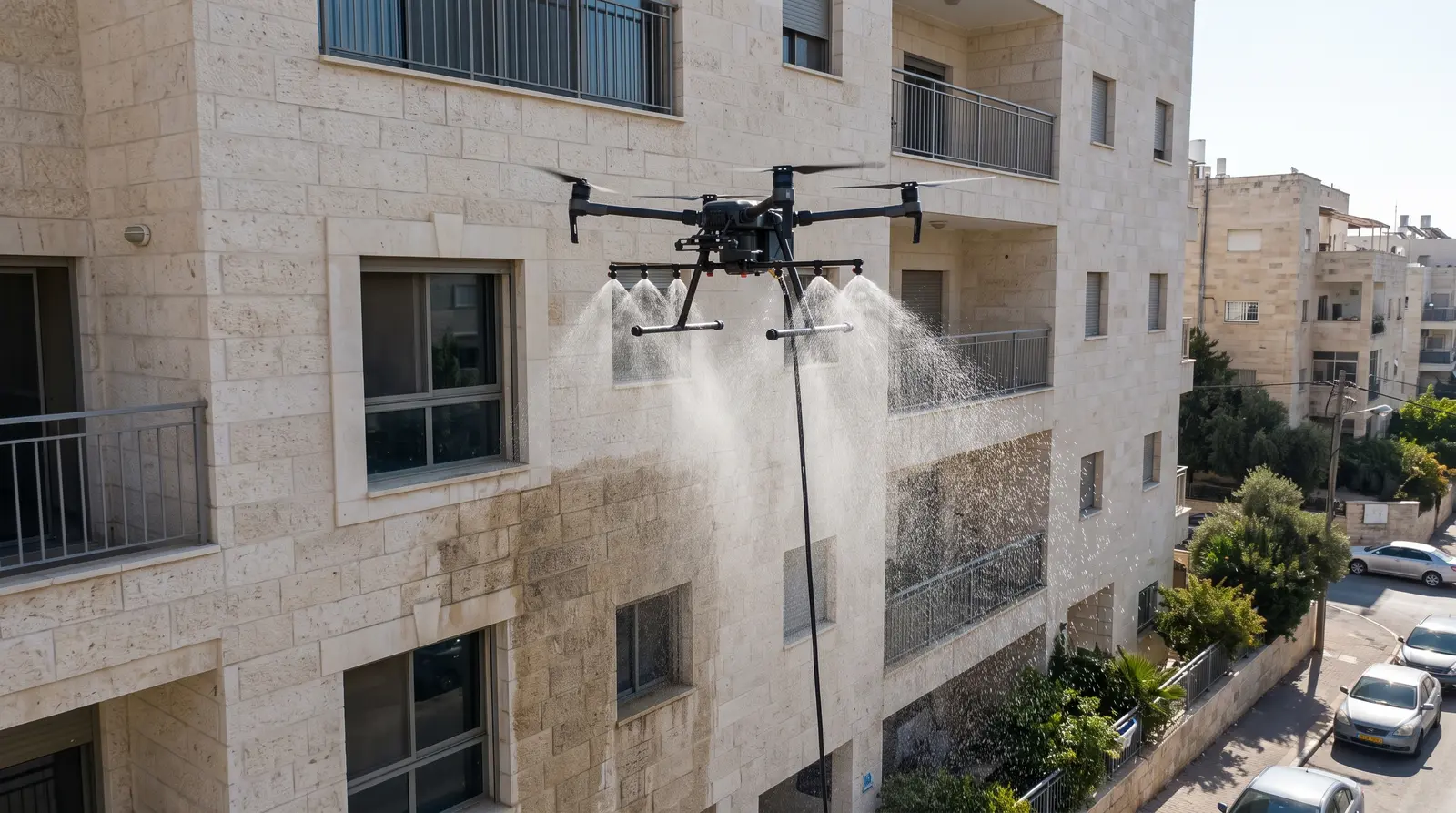
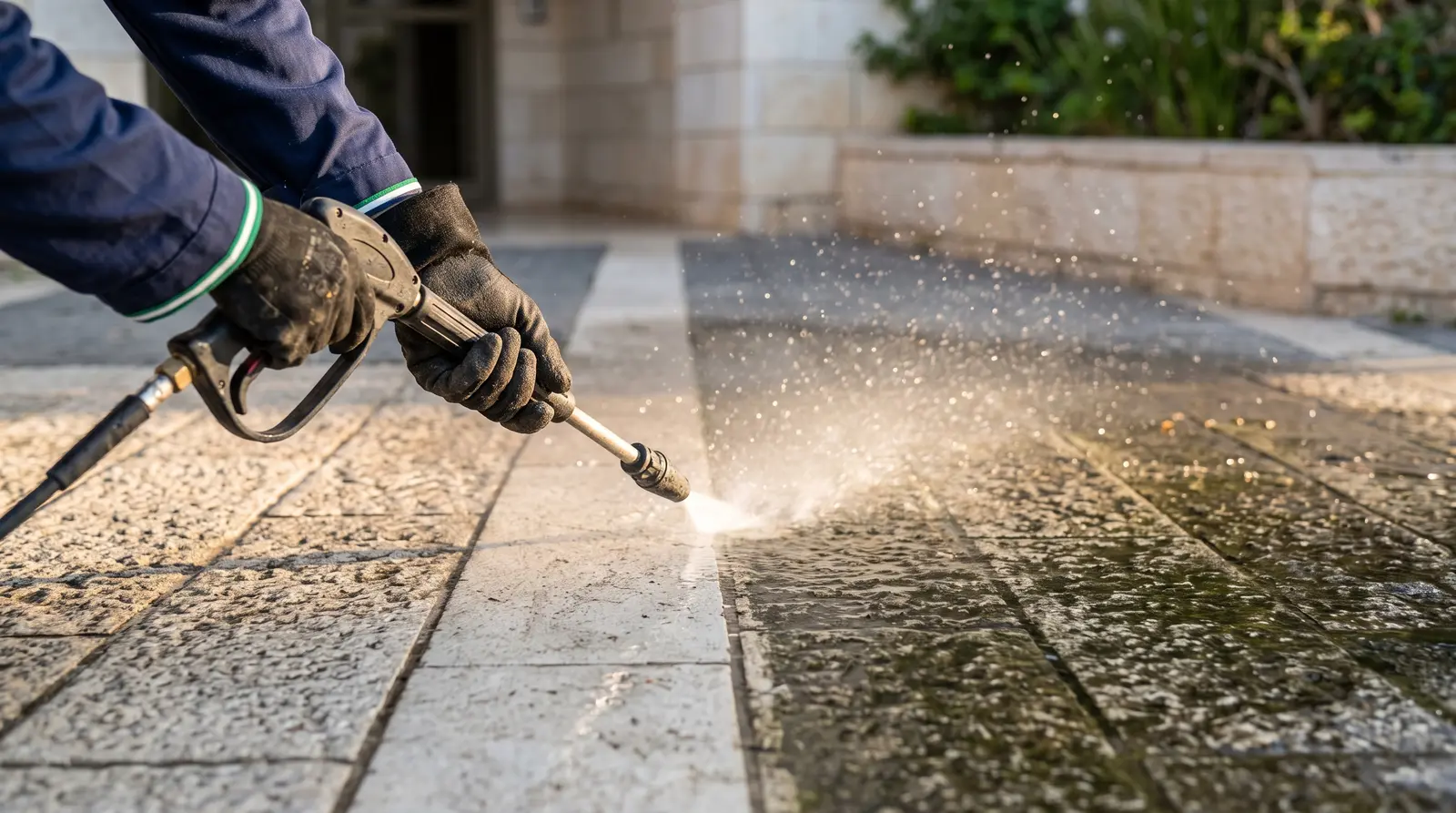
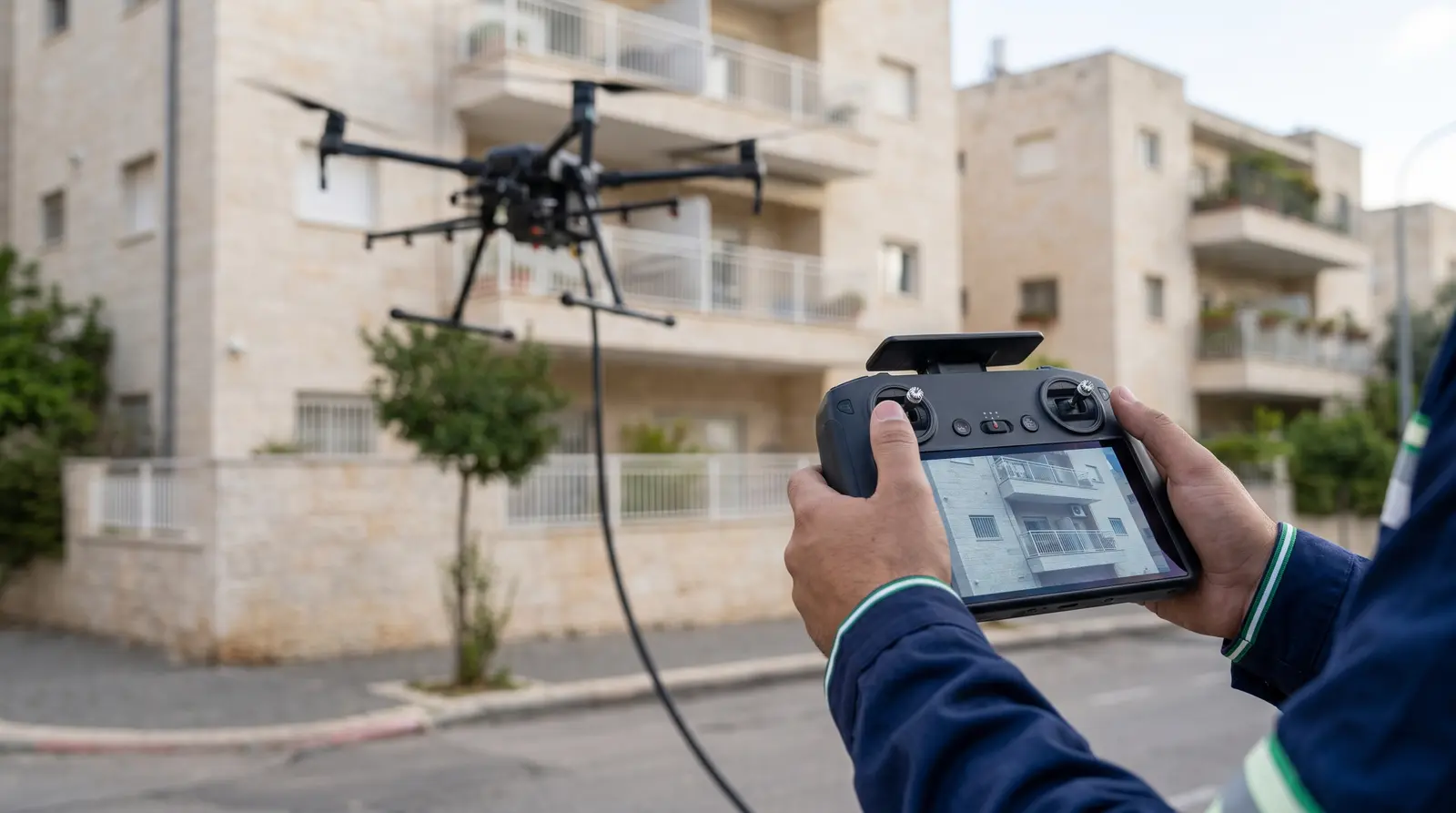
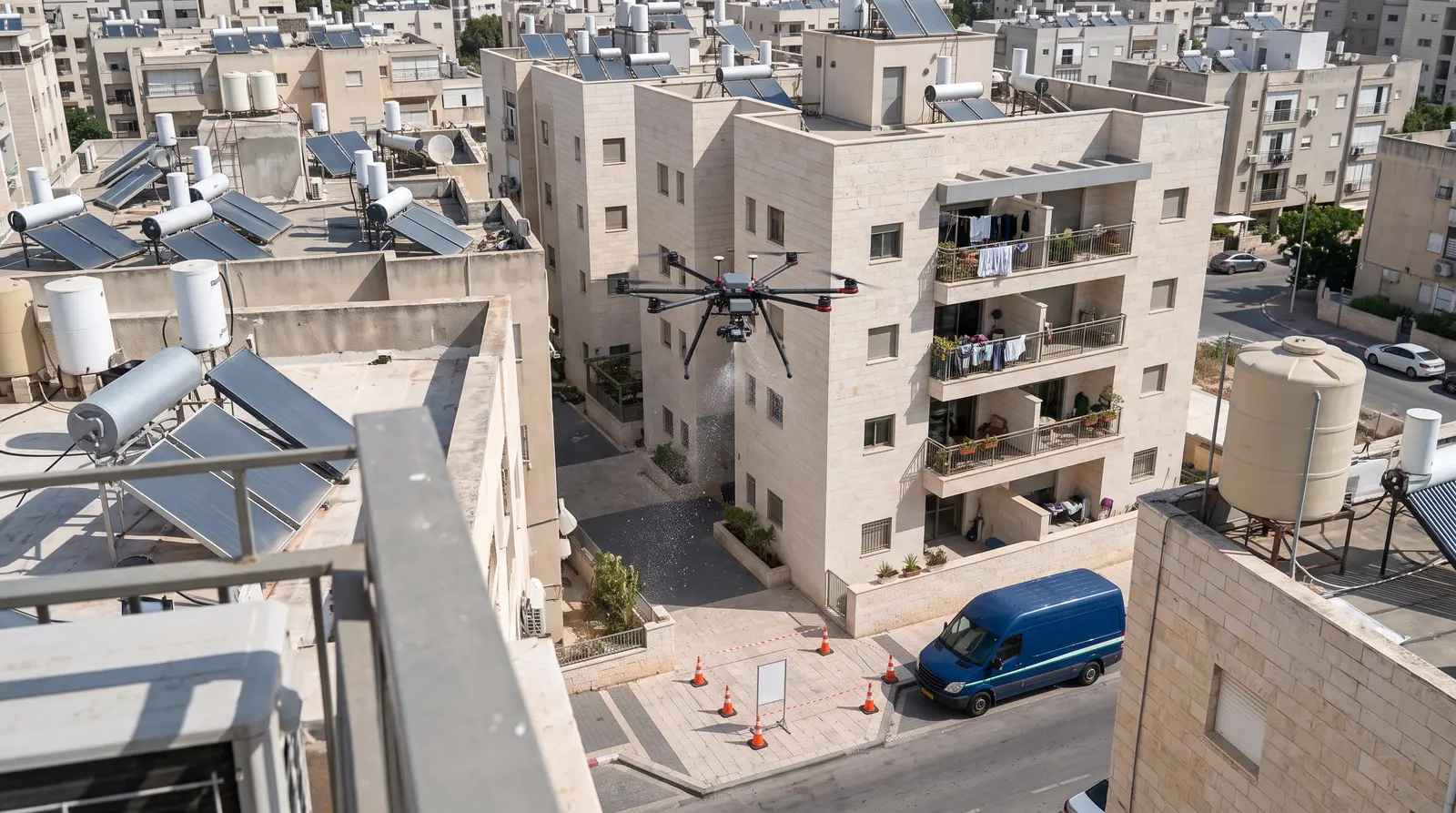
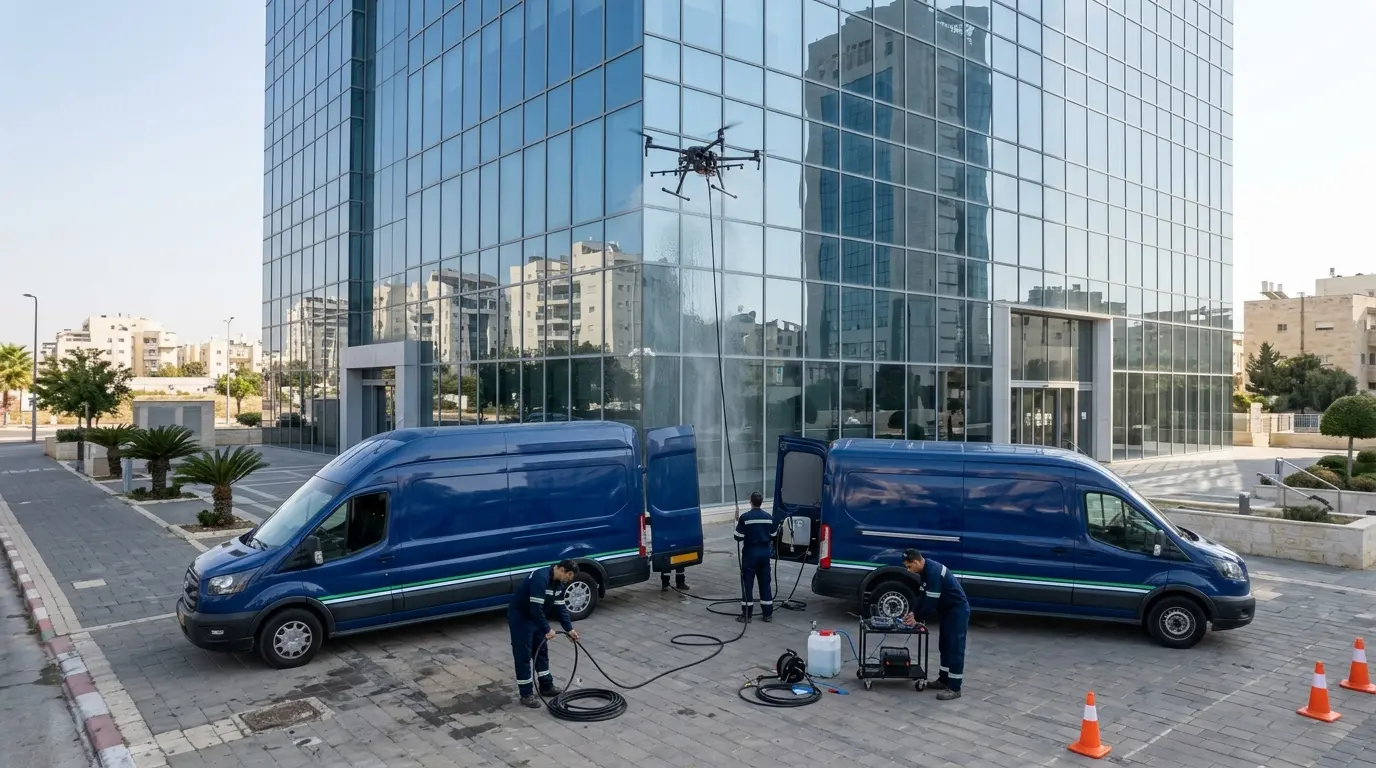
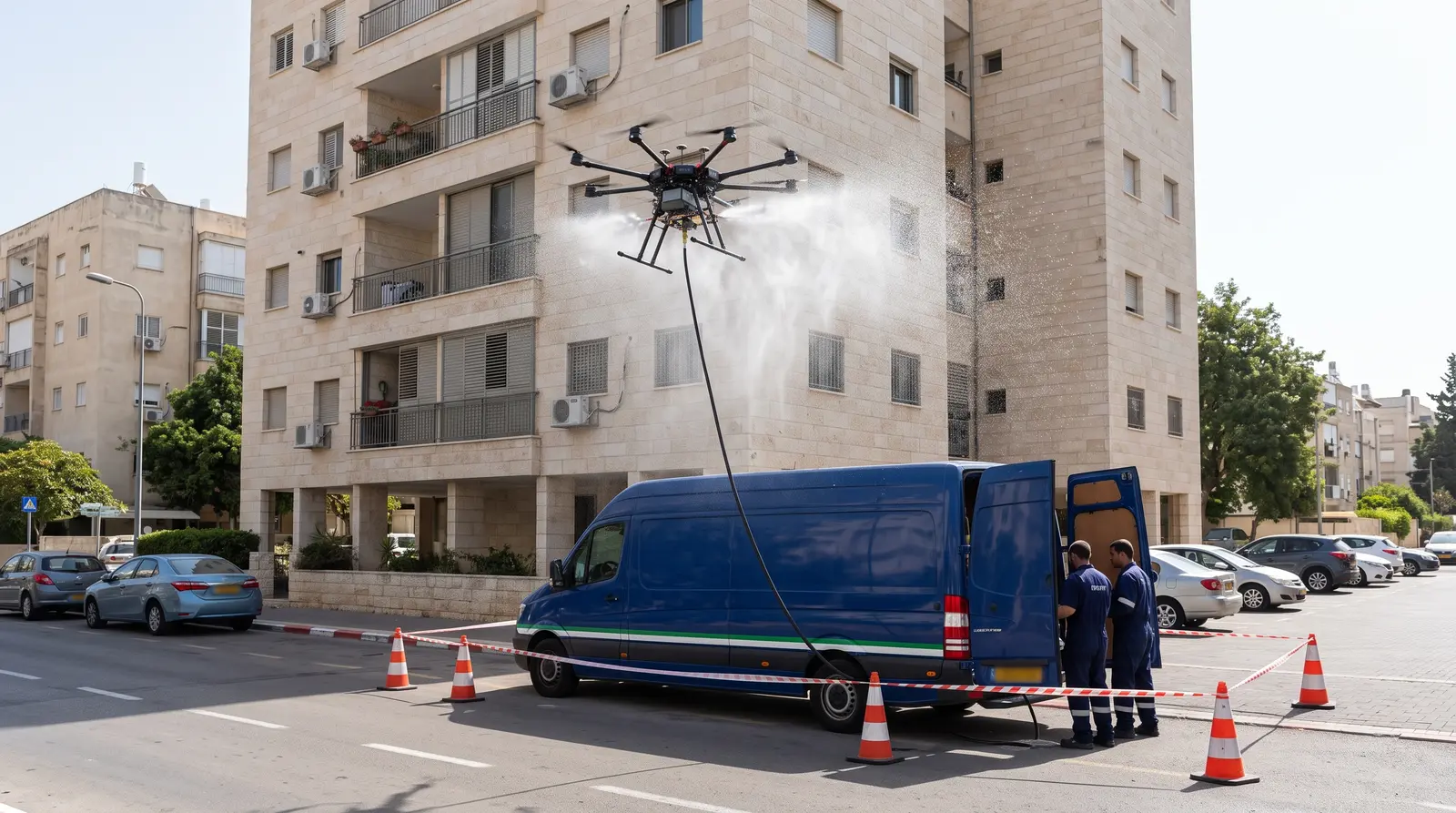
A lift drone carries the lance to the top of the building. No scaffolding, no boom lift, no closed pavement.
§The co-founders
Two brothers, two complementary halves of the same trade: one reads the building and builds the tools, the other knows pressure and the field.
 DavidCo-founderTwelve years of pressure washing in France — drain unblocking, drain jetting, network maintenance. He knows pressures, nozzles and what a surface can take without being damaged. Recently moved to Israel, investor profile: he knows what a production day is worth and he arbitrates the spending.
 JonathanCo-founderEngineer, ten years in Israel, and the idea comes from him. Former RGE-certified auditor in France: he reads a building and masters the trade software. Passionate about technology, he carries the website, the CRM and the marketing — so the roll-out and the virality.
§Operational summary
We are setting up a cleaning company in Israel specialised in pressure washing, with the drone alongside. The drone is not the trade: it is the means of access that carries pressure washing up to the top floor, without scaffolding and without a boom lift.
·The five facts that sum up the dossier
- The market exists and nobody serves it. Close to three million homes in Israel, most of them in blocks of flats, and five drone operators who address only Intel, the Israel Electric Corporation and Dead Sea Works.
- The drone does not occupy the street. No scaffolding, no boom lift, no highway permit, no closed pavement. In an Israeli city centre, that is the argument that gets the contract signed.
- Regulation is a barrier, not an obstacle. The 2024 regulation effectively prohibits our trade without a special operating authorisation granted on file. It takes months and it has to be earned. Once obtained, it cannot be bought.
- We are not starting from nothing, and pressure washing is not a side trade. Drain jetting and pipe maintenance have been David’s trade for twelve years, and it is exactly the same physics applied vertically. A single van carries the drone and the ground equipment. In concrete terms: pressure washing invoices from the third month and keeps the company alive while the flight file is being processed, it fills the days when the wind grounds the aircraft, and it opens the doors of the same clients. It is half the model, not a spare wheel.
- The founders take no salary in the first year. They are paid at the end of the financial year, out of the result.
1The marketExplanations→
1.1How a façade is cleaned in Israel today
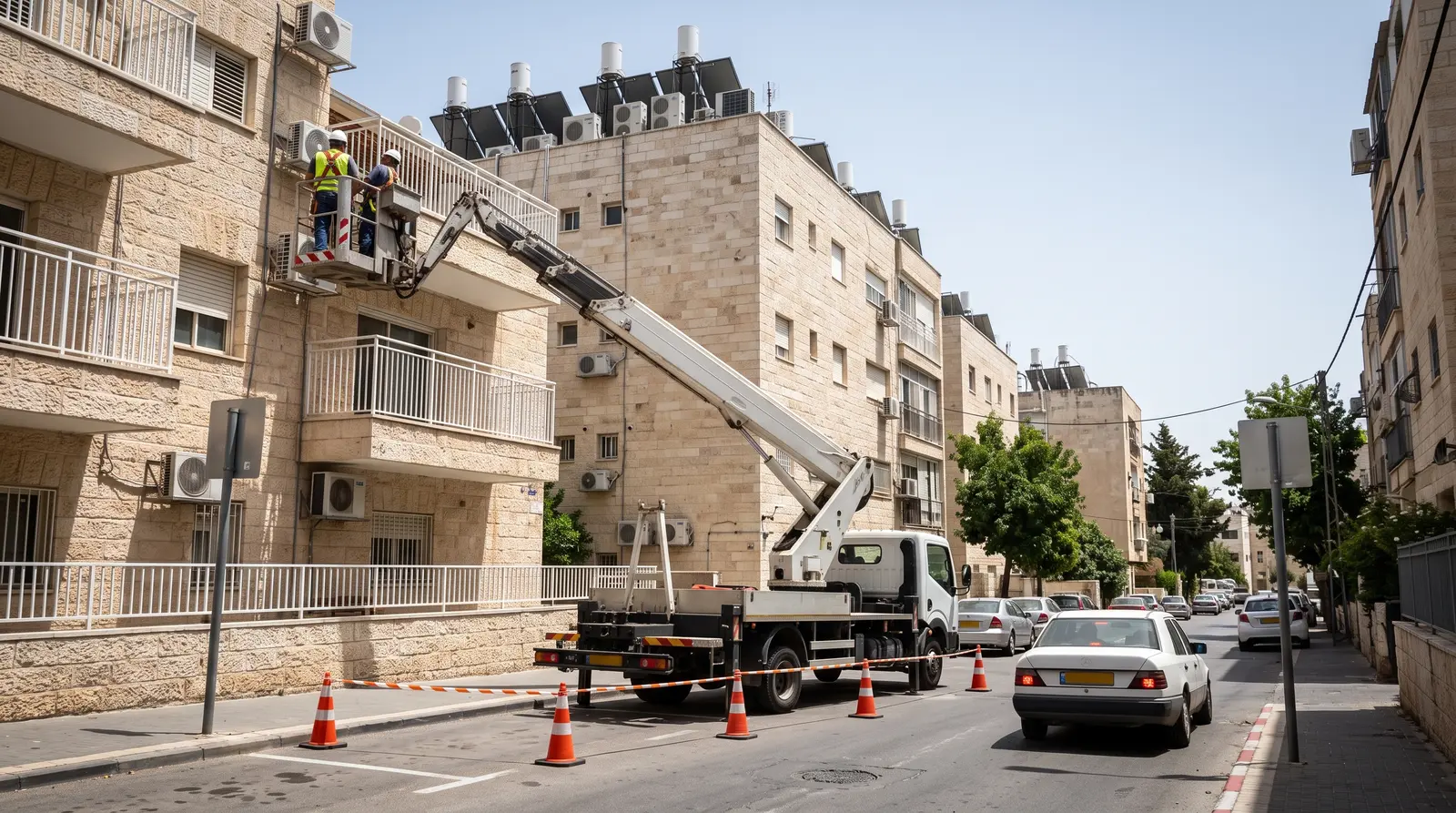
Three methods, all of them older than on-board electronics. The rope access technician abseils down from the roof: quick to set up, but the cost follows the height and the risk follows the man. The boom lift raises an operator from the ground: cheaper up to six storeys, but it takes a traffic lane, a highway permit and parking spaces. Scaffolding is only justified on long jobs.
Nothing has moved in twenty years. A mature, fragmented market — close to two thousand companies listed — running on manual quotes and word of mouth.
 1.1
1.11.2The real cost of the current methods
| Method | Observed price | Constraints |
|---|---|---|
| Rope access | 30–50 ₪/m² · flat rate 3 300–5 900 ₪ per building · team 3 000–3 500 ₪/day | Surcharge of 15 to 25% above 11 storeys, 25 to 40% above 20; +20% in the coastal strip |
| Boom lift | 2 500–15 000 ₪/day depending on height | 20 to 30% cheaper than rope access up to 6 storeys, but highway permit and occupation of the carriageway |
| Scaffolding | Quoted per project | Long immobilisation, heavy nuisance for residents |
1.3The addressable stock
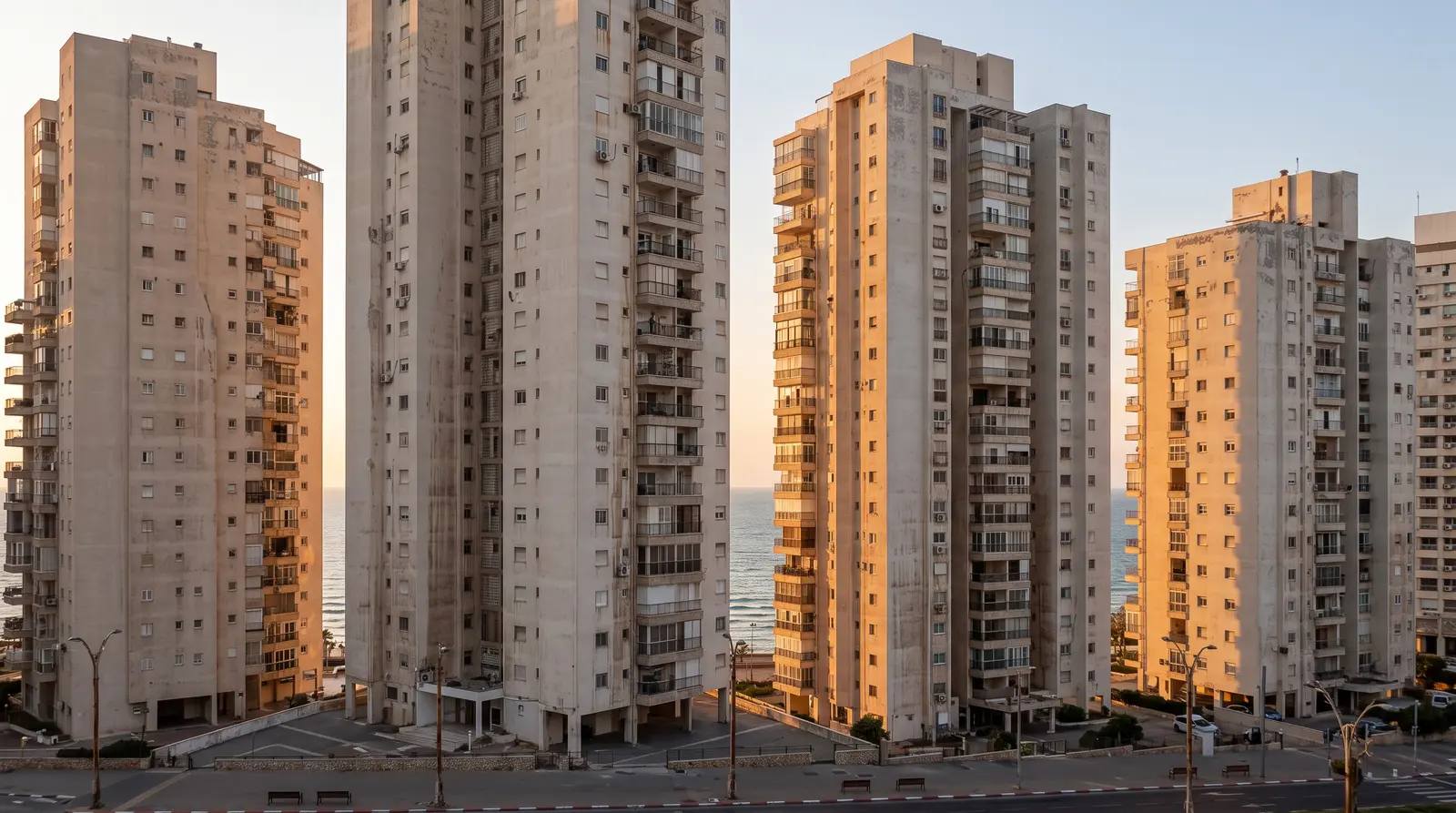
Israel has around 2.96 million homes, growing by more than 61 000 units a year. New construction is vertical: in 2024, 47.5% of new homes were in buildings of nine storeys or more, and close to 80% of the floor area started was residential.
Verticality is concentrated where we want to work. In 2023, the homes started in towers of sixteen storeys and above were counted first in Bat Yam (1 486), then Ashdod (732), Lod (697), Netanya (694) and Rishon LeZion (651). Tel Aviv comes only eighth with 426 — but that is where parking is impossible, so that is where our argument carries the most weight.
 אוסמוז
Sea salt changes the nature of the need along the coastal strip. A façade exposed to spray degrades visibly in two to three years, where an inland building holds for ten. Bat Yam, Ashdod and Netanya therefore combine both vertical density and a recurring need — that is where we open.
1.4Our two markets
We address two client bases with two aircraft, two regulatory regimes and two timetables.
| Offer AResidential and small blocks | Offer BHigh rise | |
|---|---|---|
| Share of jobs | 75% | 25% |
| Target | Buildings of 3 to 10 storeys, small building committees, villas | Residential towers, hotels, offices, industrial sites |
| Aircraft | Two drones under 25 kg | Industrial system over 25 kg |
| Regime | 2024 regulation, pilot licence, special operating authorisation | 1981 regime, air operator status, certificate of airworthiness |
| Available from | Month 7 | Month 24 |
| Typical duration | 1 to 2 days | Three to five days |
| Average ticket | 9 812 ₪ | 20 000 ₪ |
This sequence is not a matter of comfort, it is the structure of the dossier. Offer A starts early, under the lighter regime, with two light aircraft; it then finances the opening of offer B, which demands a far longer regulatory path. We are not asking the bank to finance two simultaneous bets, but a first one that pays for the second — and the purchase of the heavy drone is only committed in month twenty if the first eighteen months have delivered what they promised.
1.5Seasonality and recurrence
Two seasons drive the activity. From November to March, rain and wind cut the number of flyable days — we allow for a loss of about 25% of drone activity over those five months, a figure carried straight into the forecast. From April to October, dust and khamsin episodes soil façades quickly, and demand peaks before the Tishrei holidays, when building committees traditionally vote their maintenance work.
That is exactly why ground-level pressure washing is not a side activity but a shock absorber. On the days the drone stays on the ground, the team handles car parks, lobbies, terraces and drains, with the same van and the same clients. None of our drone competitors can do that.
1.6The competition
Five drone operators identified in Israel. All of them announce residential work on their website. Not one shows a single reference for it.
| Operator | Documented references | Actual segment |
|---|---|---|
| E-DRONE | Intel Haifa, Dead Sea Works, Atidim complex · 1.2 million m² claimed | Industry and large accounts |
| Aquadrone | No case study published | Announces residential towers, without proof |
| KTV Working Drone | No named reference | Infrastructure, energy, oil & gas |
| TDrone | No named reference | Buildings, solar, wind, aeronautics |
| DXG Drone Services | Website unreachable | Not determined |
A foreign franchise, Drone Sky Cleaners, markets an Israeli territory, without any active franchisee having been identified.
2The solutionExplanations→
2.1The principle
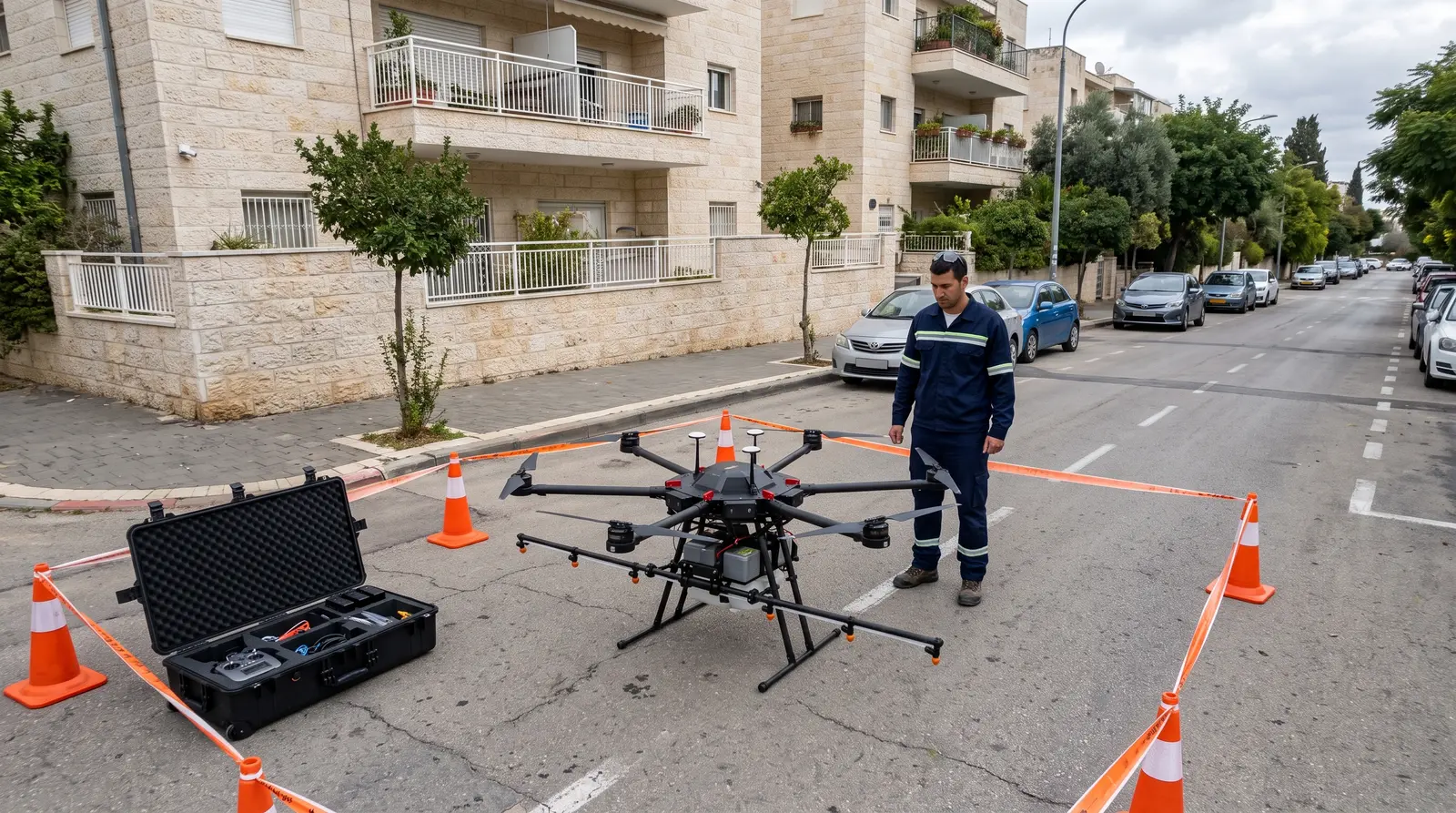
A carrier drone, fed from the ground through a hose, sprays pressurised osmosis water onto the façade. The water, stripped of its minerals by a reverse-osmosis unit carried in the van, dries without leaving a mark: no squeegee, no detergent residue, no human contact with the surface. The pilot works from the street; the ground operator manages the buffer tank, the water supply, the pump, the safety marking and the visual watch the regulations require.
The façade of a six-storey building is done in half a day, and no resident has to keep the windows shut for more than an hour.
 אוסמוז
2.2What the drone does, and what it does not
| Where the drone excels | Where the drone is the wrong tool |
|---|---|
| Glass, aluminium, cladding, smooth stone, painted concrete | Ingrained soiling, graffiti, thick old moss |
| Continuous, unobstructed surfaces | Deep balconies, enclosed loggias, architectural recesses |
| Solar panels, glass roofs, canopies out of reach | Wind above roughly 30 km/h |
| Buildings where ground access is impossible | Work needing mechanical contact (scraping, sanding) |
We say so to the client before we sell. A job sold on a promise the drone cannot keep costs us a bad review, and our strategy rests on reviews. When the façade needs contact, we propose a mixed job: the drone for the surfaces, a subcontracted rope access technician for the hard points. We remain the main contractor and the client deals with one company only.
2.3The comparison that wins the signature
| Criterion | Drone | Rope access | Boom lift |
|---|---|---|---|
| Time on site (six-storey building) | 1.5 days | 2 to 3 days | 2 days |
| Road space taken | None | Limited | A full traffic lane |
| Municipal highway permit | No | Depends on the site | Yes |
| Parking spaces taken out | One space | One space | Three to five |
| Staff exposed at height | None | One to three | One to two |
| Scheduling lead time | 10 days | 2 to 5 days | 10 to 20 days (permit) |
| Photo and video report of the façade | Included | No | No |
Our ten-day scheduling lead time is a regulatory constraint we cannot compress. Against a boom lift, which needs a highway permit on a similar timescale, it does not penalise us. Against a rope access technician it costs us a few days — which we offset with a job four times shorter and free of nuisance.
2.4The aircraft
We start with two aircraft under 25 kg, from two different manufacturers. This is not comfort redundancy: a grounded drone means a crew on the payroll producing nothing and a job pushed back ten days, because a flight authorisation cannot be caught up. And the cleaning-drone market is young enough that six months of side-by-side operation teach more than a year of spec sheets. Whichever model holds up becomes the standard for the second crew.
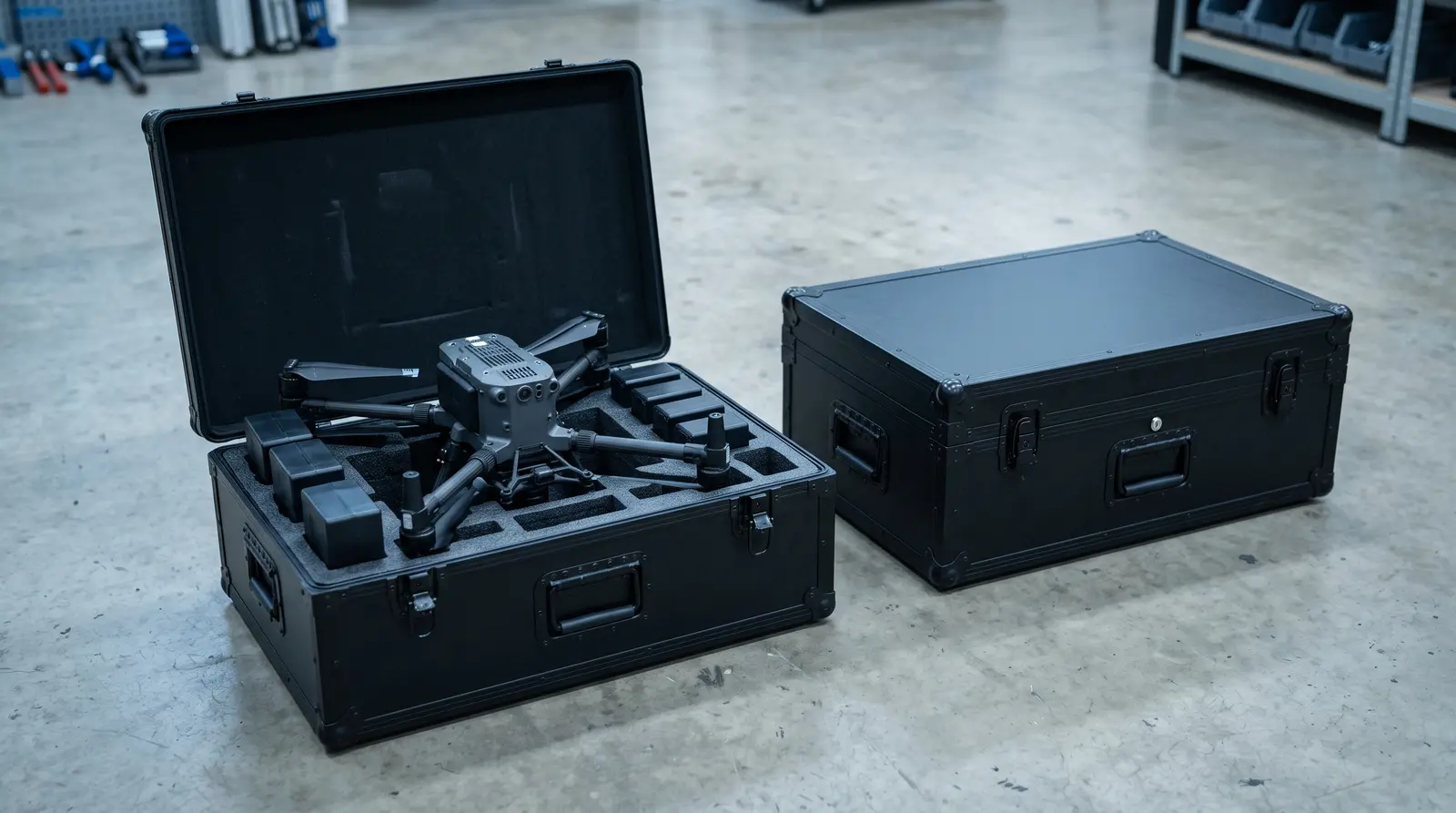
Two aircraft in month 2, for about 270 000 ₪ delivered to Israel — the order is conditional on a delivered price at or below 135 000 ₪ per aircraft, failing which a second Matrice 400 fitted with the cleaning kit takes the place of the Hercules: the Hercules 10 Tethered Spray and the DJI Matrice 400 fitted with a cleaning kit. A third in month 14 — the model that will have held up — for the second crew, operational in month 16. And an aircraft above 25 kg in month 20, for the high-rise offer, only if the first eighteen months validate the model. The detail is in section 11.1.
 אוסמוז
2.5The proof
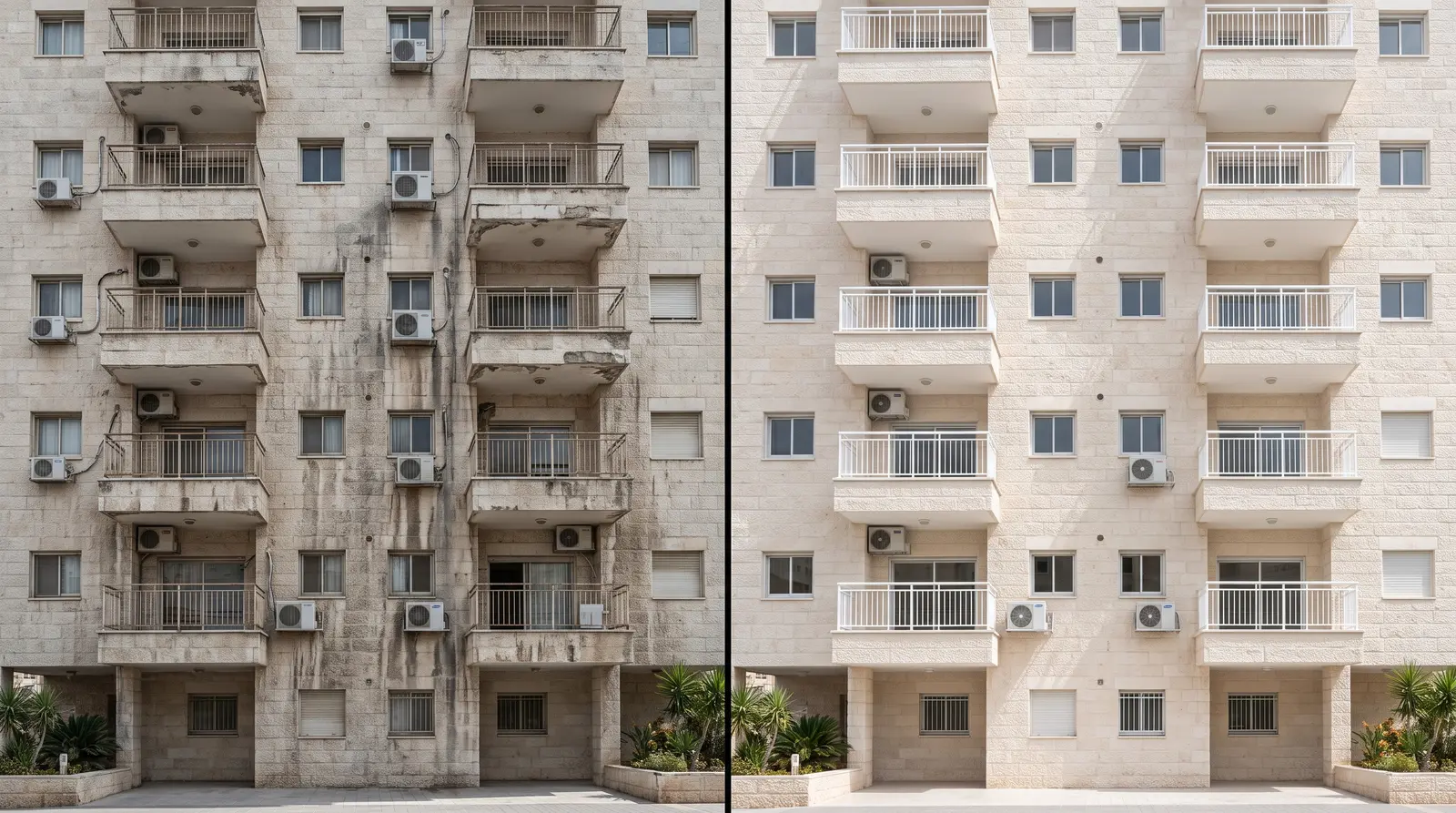
Every job produces a deliverable beyond the clean façade: a before-and-after sequence filmed from the drone, and a time-stamped mission report handed to the property management company. That report earns its keep three times — it justifies the invoice to the residents, it documents the state of the façade for the building’s insurer, and it becomes our marketing raw material.
A cleaned building is a thirty-second video. Thirty seconds that get published, get shared and sell the next job in the same street.
3The business modelExplanations→
3.1The unit that counts: the operating day
The first forecast reasoned in numbers of jobs. That is misleading: a small building and a tower share neither price, nor duration, nor margin. The only unit that really constrains the business is a field crew day, because we have only one crew.
3.2The price
We position ourselves inside the rope access price range, never below it. Undercutting a segment held by operators with very low cost structures would be lost from the start. We sell a clean site, speed, and the photo report handed to the property management company — not a discount.
| Service | Price incl. VAT | Duration |
|---|---|---|
| Four-storey building | 5 600 ₪ | 1 day |
| Six- to eight-storey building | 7 700 to 9 700 ₪ | 1.5 to 2 days |
| Tower of 12 to 20 storeys | 17 100 to 31 400 ₪ | 3 to 5.5 days |
| Solar panels in a residential building | 700 to 1 300 ₪ | 2 to 4 hours |
| Ground-level pressure washing | 4 000 ₪ per day | per day |
The full price list, its surcharges and the quoting rules are in section 12.1.
 אוסמוז
3.3The typical month, in two stages
Monthly revenue is built in two stages, separated by the arrival of the second crew in month 16 and then by the opening of offer B in month 24.
| Item | One crew · month 14 | Two crews · month 20 | Steady state · month 30 |
|---|---|---|---|
| Offer A — residential | 9.2 × 9 812 ₪ | 18.4 × 9 812 ₪ | 16.4 × 9 812 ₪ |
| Offer B — high-rise | — | — | 2 × 20 000 ₪ |
| Ground-level pressure washing | 0 d | 0 d | 3.4 d × 4 000 ₪ |
| Monthly total | 90 654 ₪ | 181 309 ₪ | 214 512 ₪ |
| Crew days used | 17 / 17 | 34 / 34 | 34 / 34 |
3.4Recurring revenue, and where it is not
Recurring revenue does exist, but elsewhere, and the forecast takes no account of it — it is potential, not a promise: solar panels in residential buildings, two passes a year at a ticket the residents’ meeting votes without difficulty; offices and facility management, three to four passes a year on an operating budget; and above all the property management company (חברת ניהול), which runs dozens of buildings, decides without a residents’ meeting and reclaims VAT. One signature, a whole portfolio.
Residential brings something else: volume, street visibility and social proof. A building is washed again every two to three years — that is the rhythm buildings can fund, and it is also the one rope access technicians recommend on technical grounds.
 אוסמוז
3.5Cost structure of a job
| Item | Six-storey building at 7 700 ₪ |
|---|---|
| Osmosis water, consumables, product | 350 ₪ |
| Fuel and travel | 270 ₪ |
| Drone wear and maintenance provision | 304 ₪ |
| Total variable costs | 924 ₪ — 12% |
| Contribution margin | 6 776 ₪ — 88% |
The contribution margin is very high, which is the signature of a service business: the whole difficulty is covering the fixed costs, not making money on a job. That is why filling the schedule, and therefore the sales machine described in section 6, comes before everything else.
3.6VAT and tax
The forecast includes Israeli VAT at 18% and corporate income tax. Over the first two months, where we invest without invoicing yet, the input VAT on equipment and vehicles generates a refundable credit that improves the cash position — a point the first forecast ignored and which works in our favour.
4The regulatory barrierExplanations→
The most important section of the dossier. It says why the first commercial flight does not take place before month 7 — while ground-level pressure washing invoices from month 3 — and why a competitor cannot catch us up in a quarter.
4.1The applicable text
Drones under 25 kg fall under תקנות הטיס (הפעלת מערכת כטב״ם קטן), התשפ״ד-2024 (the Aviation Regulations on the operation of a small unmanned aircraft system), in force since 11 August 2024. Above 25 kg the 1981 regulations apply, written for manned aviation and considerably more demanding.
4.2The rule that bans our trade
It is therefore impossible to clean an occupied façade under the standard regime. You cannot be fifty metres from a person and three metres from their window. Flying low does not help: the fifty-metre floor holds whatever the altitude.
 אוסמוז
4.3The special operating authorisation
The regulations provide the way out themselves. Articles 37 to 43 create the הרשאה להפעלה מיוחדת (special operating authorisation): the director of civil aviation may allow an operator to depart from a closed list of articles, including article 32 on distances and article 35 on heights.
That is why the first spending item of the project is not a drone but a file, and why we write the first ones ourselves: you do not write a procedure you have never carried out.
4.4What is not required
- No municipal authorisation is required in order to fly. Civil aviation is an exclusively national competence. Neither Tel Aviv, nor Haifa, nor Ramat Gan issues a flight authorisation, and no Israeli municipal by-law deals with drones.
- The only municipal formalities concern the work at ground level — road occupation, parking — and the drone escapes them most of the time, unlike the boom lift. That is a direct competitive advantage, not merely lighter paperwork.
 אוסמוז
4.5The cycle of a job
| Timing | Action | Who |
|---|---|---|
| T−15 | Site survey: access, ground perimeter, height, no-fly zones, photographic record, technical sheet | Sales engineer |
| T−10 | Flight coordination request filed with מודיעין טיס (the flight information unit) — seven working days minimum, forwarded to the air force | Administration |
| T−7 | Residents informed, written agreement from the property management company, instruction to close windows | Administration |
| T−1 | Check on temporary restrictions and weather, confirmation or postponement notified to the client | Crew leader |
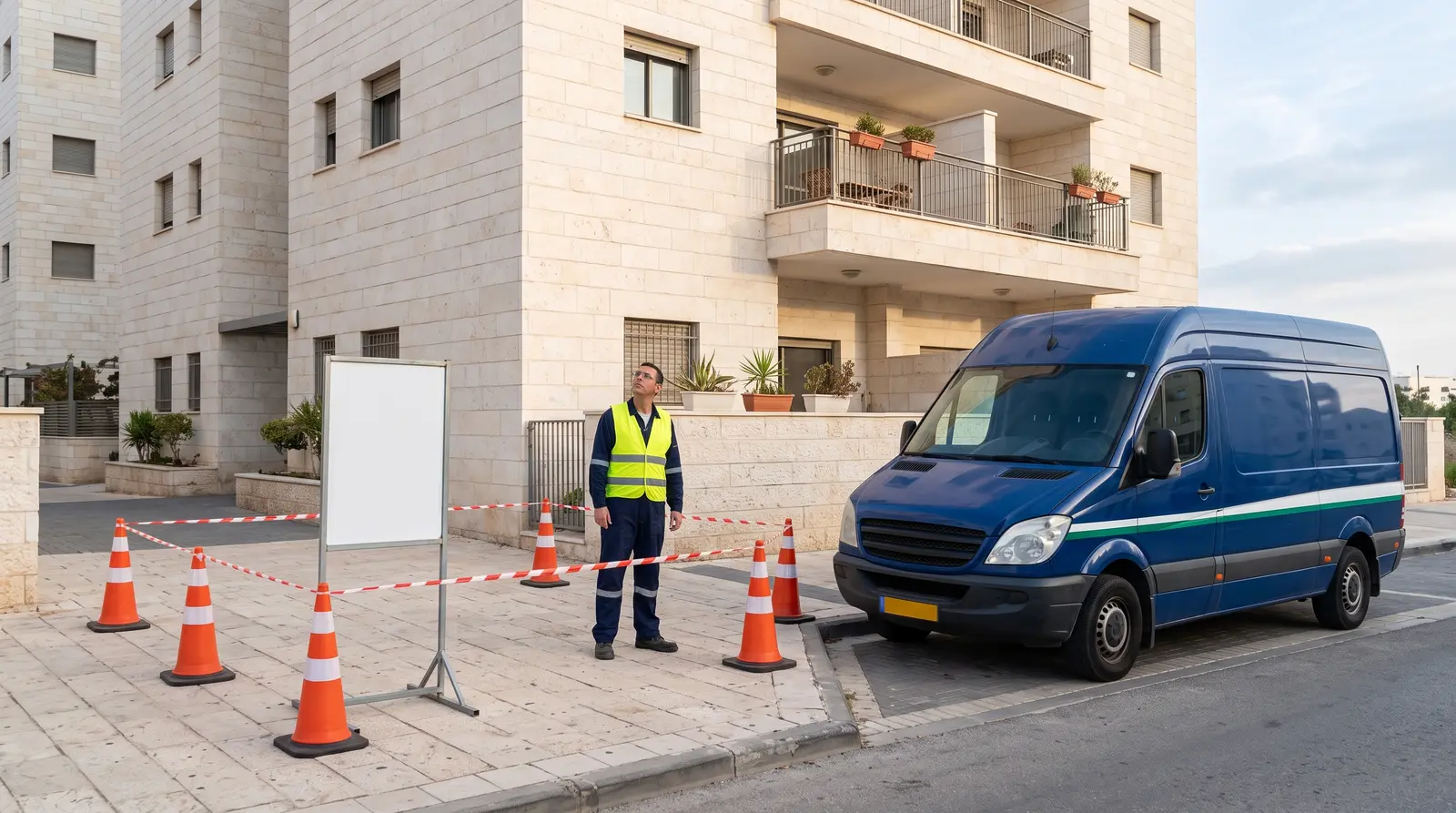
| T0 | Safety marking, call to the control unit before take-off, daylight flight, visual observer at all times | Field crew |
| T+1 | Mission report, operations and maintenance logs, invoicing, review request to the client | Administration |
The ten-day lead time cannot be compressed and we sell it as such. Our promise is not immediate intervention: it is a quote within twenty-four hours, a firm date given straight away, and a job that disturbs nobody.
4.6Timeline and plan B
| Month | Regulatory milestone |
|---|---|
| 1 | Company, lawyer, tax registrations. Van and both aircraft ordered. Recruitment of the field pair started. Website and CRM built in-house |
| 2 | Van delivered and fitted out, aircraft registered, spectrum authorisation filed. Field pair in post mid-month, settling-in and testing period |
| 3 | Risk management plan written with the consultant and authorisation application filed. Ground-level pressure washing in production. Campaign launched at T+90 |
| 4–6 | Application processed by the authority. First qualified residential leads, quotes issued, insurance taken out |
| on authorisation | Trial jobs, then the first billable drone job, on an order book already built |
| 14–16 | Drone A3 and recruitment of the second field crew |
| 18 | Review point: does the trajectory justify opening offer B? |
| 20–24 | Heavy drone, air operator status, certificate of airworthiness, opening of the high-rise offer |
If the authorisation is slow to come, three activities stay open without a waiver and cover part of the fixed costs: ground-level pressure washing, which falls under no air regulation; solar panel cleaning on open roofs, where the distance rule can be respected; and isolated industrial sites, where the absence of third parties nearby makes the flight compliant by nature. We are not left without revenue while waiting for an administrative signature.
5OperationsExplanations→
5.1The field crew
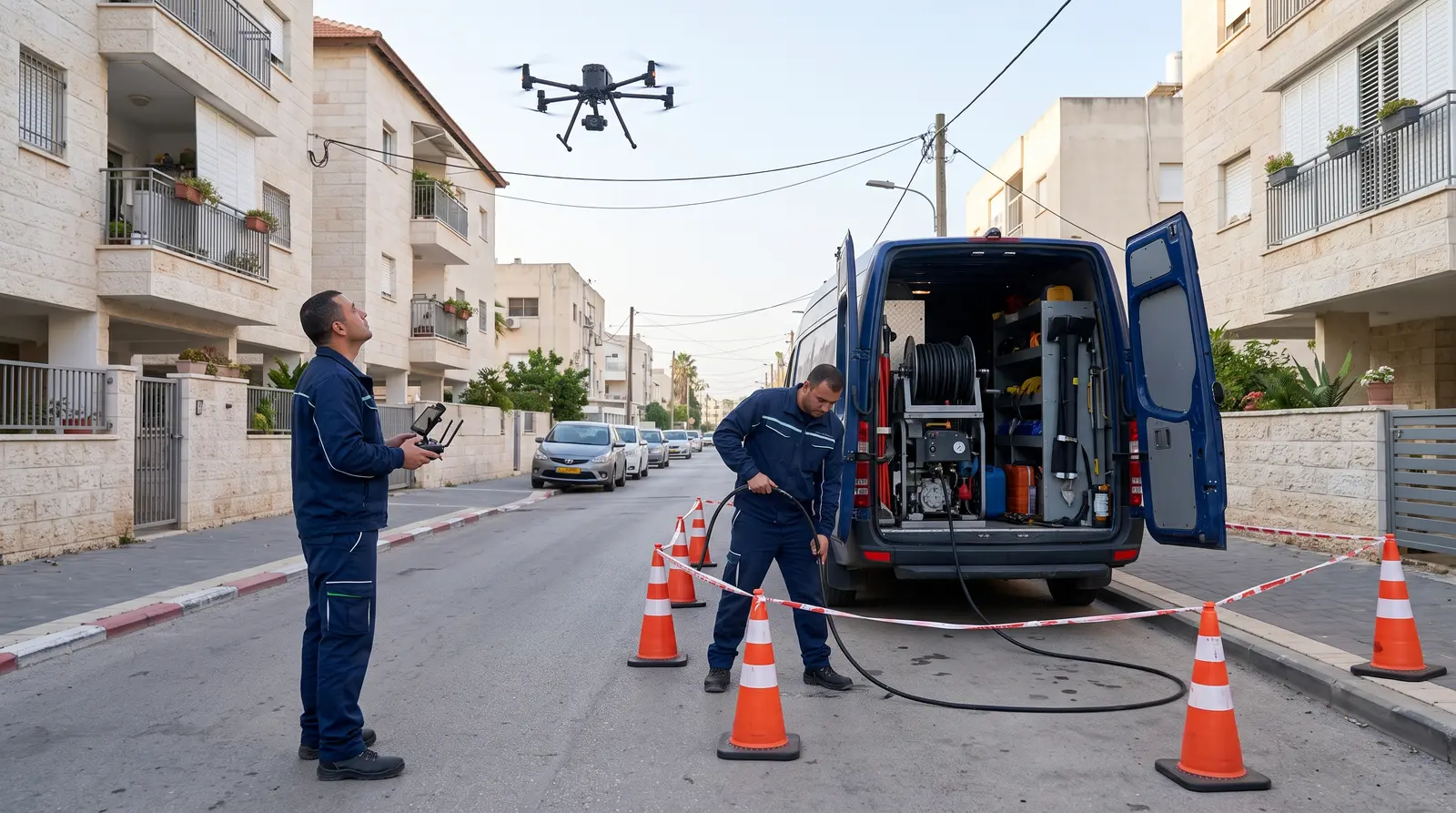
A job takes two people, and that constraint is regulatory as much as operational: the regulations require a visual observer separate from the remote pilot.
| Role | Job on site |
|---|---|
| Drone pilot | Flying, managing the flight path and the distance, deciding to postpone in case of wind, keeping the flight log |
| Crew leader / ground operator | Safety marking, tank and pump, reverse-osmosis unit, permanent visual watch, dealings with the property management company and the residents, shooting the before-and-after footage |
Two people make one crew, therefore one drone in the air at a time. The second aircraft adds no production capacity: it guarantees continuity in case of a breakdown, and it serves as a comparative test bench between two models. Increasing volume requires a second pair, not a third aircraft — which is what we do in month 16.
 אוסמוז
5.2Equipment and vehicles
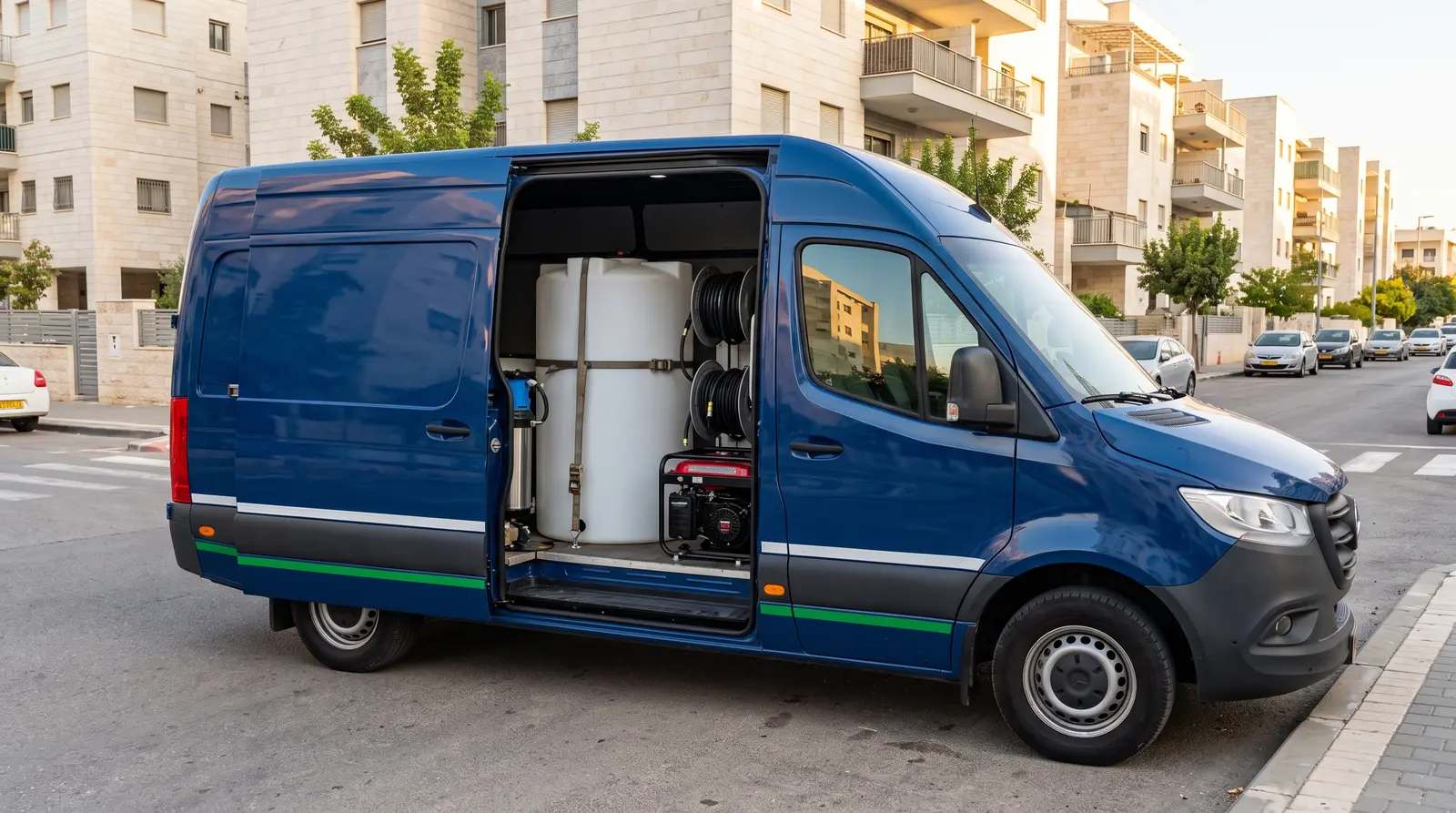
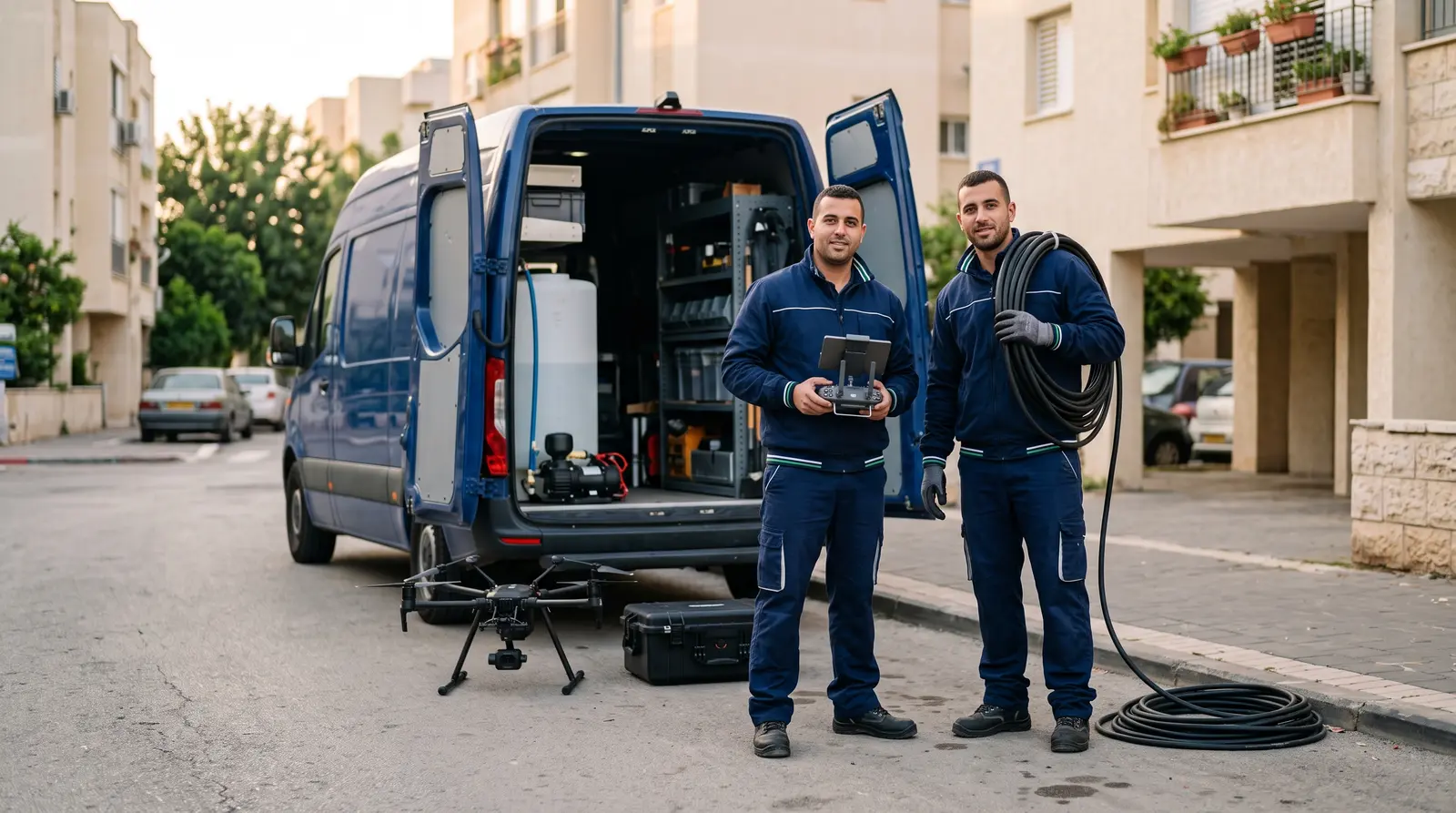
A Ford Transit 399L panel van of 3 990 kg gross vehicle weight, permanently fitted out: a 400-litre buffer tank, reverse-osmosis unit, generator, high-pressure pump, hose reels, and the drone case stowed under cover. The whole fit-out weighs 930 kg against 1 714 kg of payload. A second, second-hand vehicle for the sales engineer’s site surveys. Both are on the road from month 1, well before the first job — a mobile billboard that establishes the brand while the regulatory file is being processed.
The detail of prices, of the ten vehicles compared and of the 3 500 kg tax threshold is in section 11.
 אוסמוז
5.3Safety and incident management
Our operating authorisation depends on our safety record. Three non-negotiable principles, written into the manual and binding on the crew.
- The pilot alone decides to postpone. No commercial pressure can make an aircraft take off in excessive wind. The client is told, the date is rescheduled, the contract provides for it.
- A ground perimeter every time, marked out, with the operator keeping permanent watch. Nobody uninvolved under the working area.
- Immediate reporting of any incident, even without damage. A concealed incident that surfaces later costs the authorisation; a reported incident costs a report.
5.4Maintenance and availability
A grounded drone is a crew being paid to produce nothing. We provision maintenance inside the variable cost of every job, we keep the maintenance log the authority requires, and we hold a full set of wear parts and batteries. Both aircraft are delivered in month two: from the very first drone job, the second one guarantees continuity on offer A.
5.5Quality as a sales system
Every job ends with a report handed to the property management company, then an online review request forty-eight hours later, sent automatically from our CRM. Reviews are our first acquisition channel in a market where the building committee chooses by recommendation. A successful job is not a job delivered: it is a job that has produced a review and a video.
6Becoming the leader
6.1The positioning
We do not claim to be the first drone operator in Israel — that would be false, and checkable in thirty seconds. We claim to be the first to industrialise residential façade cleaning, while the established operators fight over industrial sites.
The difference is a difference of trade. E-DRONE and its competitors are technical companies that answer tenders. We are building a sales machine: someone on the phone who calls back within the hour, a sales engineer who goes and looks at the building, a quote within twenty-four hours, a firm date, a clean job, a review requested. It is call-out service know-how applied to façades, and it is exactly where we come from.
6.2The filmed job
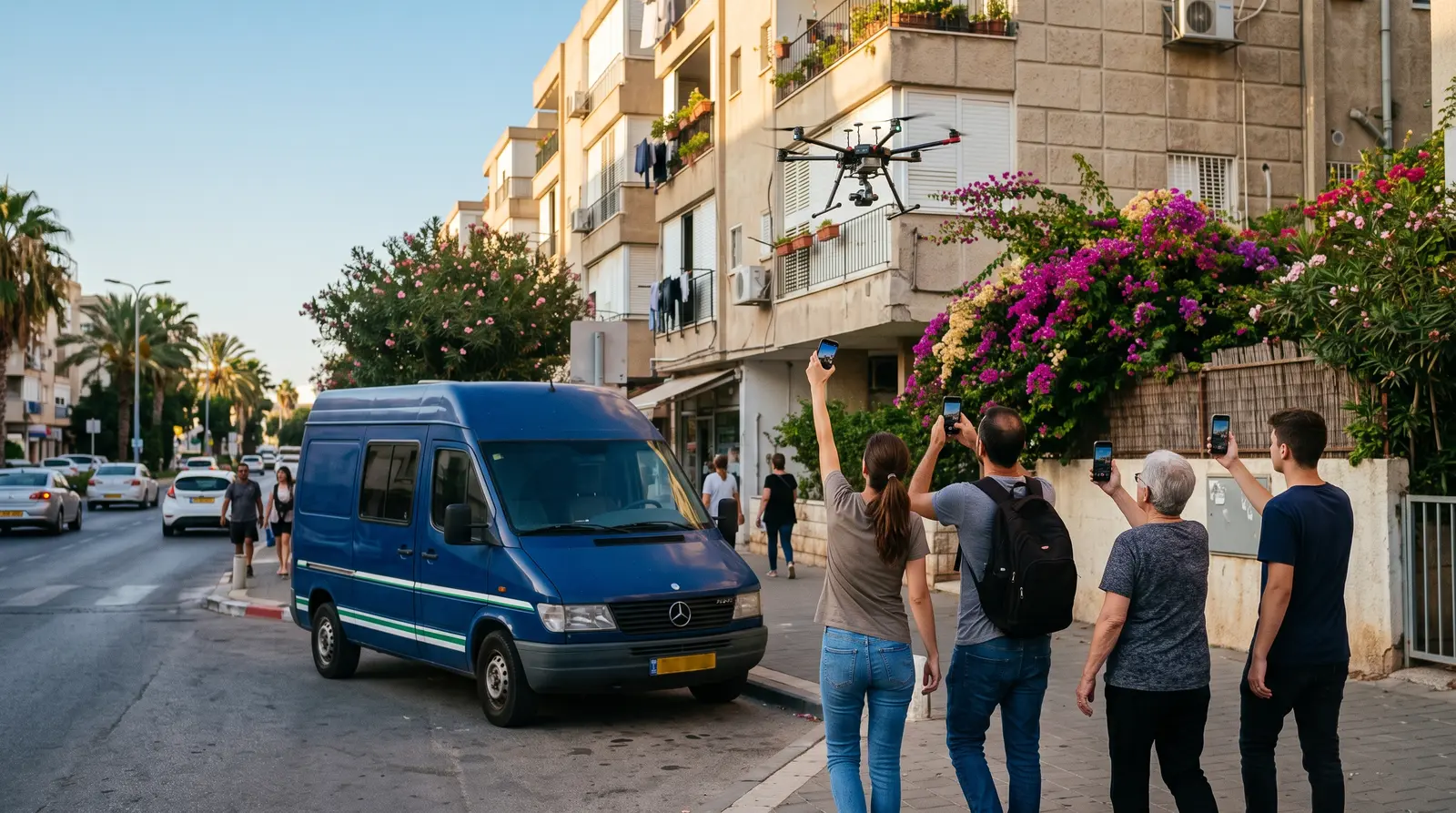
Our main marketing budget is not advertising, it is production. A drone washing a tower is a spectacle: it stops people in the street, it gets filmed, it gets shared. Every job produces footage usable as a short post, as a sales demonstration and as proof of competence in a tender file.
We are aiming for one post per job from the first month of operation, and a library of visual references built with no additional advertising budget. In a market where nobody shows anything, the one who shows wins.
 אוסמוז
6.3Acquisition — residential
| Channel | Target | Role |
|---|---|---|
| Property management companies | Portfolios of 20 to 100 buildings | Priority channel: one signature opens a portfolio |
| Building committees | Blocks of 12 to 60 units | Direct prospecting by the sales engineer, targeted on visible façade condition |
| Local search and business listing | Inbound enquiries | Handled within the hour by the phone sales rep |
| Social media and video | Awareness and inbound demand | Fed by the jobs themselves |
| Customer reviews | Recommendation between property managers | Systematised after every job |
The sales engineer’s prospecting is not blind: a dirty façade can be seen from the street. He spots it, photographs it, identifies the property manager and passes the sheet to the phone sales rep, who calls. The product sells itself by sight.
6.4Acquisition — key accounts
Offer B sells differently: long cycle, tenders, references required. We are targeting hotel chains, office-park managers, hospitals and industrial sites. The first tower job will probably be sold at a loss or at cost: it is a reference we are buying, and it is worth more than its margin.
 אוסמוז
6.5The pipeline required
Fifteen jobs a month at cruising speed with two crews — nine with a single one —, with a prudent conversion rate of 25% on quotes issued and 40% of quotes on qualified leads, require about 150 qualified leads per month. That is the only figure that has to hold: everything else in the model follows from it.
6.6The first ninety days
- Brand identity, wrapping of the two vehicles, business listing and local online presence.
- Building the prospecting file: property management companies, building committees, hotels, by priority city.
- Setting up the CRM and the templates for field surveys, quotes, mission reports and authorisation files.
- Filming a demonstration video on a private site, with no regulatory constraint, so we can sell before the first job.
- First meetings with three target property management companies, to sign framework agreements conditional on obtaining the authorisation.
7The team
7.1The founders
Two brothers, two complementary halves of the same trade.
| Partner | What he brings |
|---|---|
| Jonathan the elder, co-founder |
Engineer, ten years in Israel. The idea comes from him. Former RGE-accredited auditor in France: he can read a building and knows the sector’s software. Passionate about technology, he carries the website, the CRM and the marketing — rollout, image, virality. |
| David the younger, co-founder |
Twelve years of pressure washing in France — drain unblocking, sewer jetting, network maintenance. He knows pressures, nozzles, water treatment and what a surface takes without being damaged: it is the same physics as a façade, applied horizontally. He knows what a production day is worth and he can price it. Recently moved to Israel, investor and marketing profile: he arbitrates the spending. |
We take general management, budgets, decisions and marketing. We build and run our management systems ourselves — website, CRM, job tracking, document automation. That is what makes credible both the regulatory file, which is an exercise in drafting and procedure, and the commercial volume, which is an exercise in organisation. Neither of us draws a salary in the first year; remuneration comes at the end of the financial year, out of the profit.
7.2The posts
| Post | Remit | Status |
|---|---|---|
| Drone pilot | Flying, flight safety, flight log, decision to postpone | Recruited already licensed — search launched in month 1, starting mid-month 2 |
| Crew leader | Ground operator, running the job site, dealings with residents, filming | Candidate identified |
| Field sales engineer | Site surveys, technical measurements, putting together the authorisation files, visual prospecting | To be recruited, dedicated wrapped vehicle |
| Phone sales rep | Handling inbound enquiries, quotes, follow-ups, booking appointments — bilingual Hebrew-French | To be recruited |
| Administrator | Flight coordination, dealings with the authorities, invoicing, CRM follow-up — bilingual | To be recruited at a second stage; covered by the founders at the start |
7.3Recruiting the pilot
The pool exists and it is Israeli. The army trains a large number of drone operators every year. These profiles come out of service with real flight hours, a culture of procedure and safety, and the seriousness an authorisation file demands. It also strengthens our application to the authority: an operator who presents an experienced pilot defends its risk management plan better.
Recruitment starts in the first month, for a start mid-month two. The lead time is no longer training, it is an adaptation and testing period on our own equipment — and it is spent producing ground-level pressure washing, not sitting in a classroom.
 אוסמוז
7.4The pay scale
The Israeli minimum wage stands at 6 443.85 ₪ gross per month since 1 April 2026 for a full-time post. No position can be paid below it, commissions included.
| Post | Gross monthly | Employer cost | Net, resident | Net, new immigrant |
|---|---|---|---|---|
| Drone pilot | 13 000 ₪ | 15 600 ₪ | ~10 200 ₪ | ~10 900 ₪ |
| Crew leader | 11 000 ₪ | 13 200 ₪ | ~8 800 ₪ | ~9 500 ₪ |
| Sales engineer | 12 000 ₪ | 14 400 ₪ | ~9 500 ₪ | ~10 200 ₪ |
| Phone sales rep | 6 450 ₪ floor + commission | 7 740 ₪ + comm. | ~5 600 ₪ | ~5 900 ₪ |
| Administrator | 10 000 ₪ | 12 000 ₪ | ~8 100 ₪ | ~8 700 ₪ |
| Founders | 0 ₪ | 0 ₪ | Bonus on the annual profit | — |
| Payroll at cruising speed | ~63 000 ₪ |
The employee’s status is a recruitment lever. A new immigrant (olé hadash) receives additional tax credit points: at equal gross, he takes home about 700 ₪ more per month. Put another way, for the same net offered to the candidate, we pay about 900 ₪ less in gross. The employer cost itself does not change. The forecast treats this parameter as a variable, not as a constant.
7.5The hiring sequence
Recruiting all five posts in the first month would kill the cash position. The order follows value creation — and it has tightened noticeably since the pilot is recruited rather than trained.
- Month 1 — nobody, but everything starts. The partners incorporate the company, order the van and the aircraft, build the website and the CRM, open the regulatory file. Recruitment of the field pair is launched in that same month.
- Mid-month 2 — drone pilot and crew leader. The two arrive together. The pilot is recruited already licensed: what follows is not training but a period of adaptation and testing on our own equipment, done while producing.
- Month 3 — ground-level pressure washing goes into production. The pair is operational and invoicing, four months before the first commercial flight. The website and the campaign go live at day 90.
- Month 4 — the sales engineer. He arrives when the first qualified building committee leads come in, so he converts rather than cold-canvasses.
- Month 8 — the phone sales rep. When there are inbound enquiries to handle, not before.
- Month 18 — the bilingual administrator. She arrives with the second crew, when flight coordinations exceed fifteen a month and the procedure has been run in by the partners themselves. The single-crew scenario does not recruit her: the partners hold the coordination.
- Month 16 or later — the second field pair. On measured triggers only, never on the calendar.
 אוסמוז
7.6External advisers
- Israeli lawyer — incorporation, shareholders’ agreement, employment contracts and client contracts, securing the regulatory side.
- Accredited regulatory consultant — risk management plan and special operating authorisation file. Critical item, engaged first.
- Accountant — VAT, payroll, employee status, filing obligations.
- Aviation insurance broker — aviation third-party liability, hull damage, damage to structures.
8The forecastExplanations→
The model is built in intervention days, with Israeli VAT at 18%, corporate income tax, seasonality and the collection lag. It is built without any working capital loan: the 600 000 ₪ of founders’ equity contribution covers start-up and operations, and the cash position never turns negative. The debt requested covers the equipment only — 369 000 ₪ of balloon loan pledged on the van and the two aircraft — plus a 100 000 ₪ overdraft facility, which stays there as a safety net and costs nothing as long as it is not drawn.
8.1A light structure, and what it changes
We are not setting up a conventional company. The office already exists, the website and the CRM are built in-house, the vehicle and the drones are financed by balloon loan rather than bought outright, and the pilot is recruited already licensed rather than trained for five months at our expense. The field pair comes in mid-month two and produces pressure washing from month three, four months before the first commercial flight.
8.1bThe 69 707 ₪ of fixed costs, line by line
This is the denominator of the break-even: it has to be verifiable line by line. Single-crew cruising speed, from month eight onwards, administrator not recruited.
| Item | Monthly amount | From month |
|---|---|---|
| Drone pilot and crew leader — fully loaded employer cost | 28 800 ₪ | 2 |
| Field sales engineer — fully loaded employer cost | 14 400 ₪ | 4 |
| Phone sales rep — legal floor, loaded, excluding commissions | 7 740 ₪ | 8 |
| Balloon loan on the two aircraft | 3 547 ₪ | 3 |
| Balloon loan on the van | 3 320 ₪ | 3 |
| Insurance — aviation third-party liability, hull damage, fleet, premises | 5 000 ₪ | 5 |
| Office, telecoms, software licences, sundries | 4 500 ₪ | 1 |
| Accountant and management fees | 900 ₪ | 2 |
| Recurring marketing, excluding the launch budget | 1 500 ₪ | 3 |
| Total at cruising speed | 69 707 ₪ | 8 |
| Bilingual administrator — not recruited in this scenario | + 12 000 ₪ | 18 |
| Second field pair — not recruited in this scenario | + 28 800 ₪ | 16 |
8.2The assumptions
| Assumption | Value | Justification |
|---|---|---|
| Production days per month | 17 | Twenty working days, less wind, rain and flight restrictions |
| Duration of a façade job | 1.84 days | Weighted average of the price list, at 900 m² washed per day |
| Average façade ticket | 9 812 ₪ | Weighted average of the size mix — section 12.1 |
| Pressure washing day | 4 000 ₪ | Our current trade, known rate |
| Pressure washing, from month 3 | 17 days | The pair is assigned to it full time for as long as the drone is not flying |
| Seasonality | −25% | From November to March, on drone activity only |
| Deposit on order | 40% | Balance collected at sixty days |
| Variable costs | 12% | Water, consumables, fuel, wear |
| Date the authorisation is obtained | Month 7 | The only assumption we do not control. Sensitivity in § 8.6 |
8.3The investment
The drones and the van are financed by balloon loan pledged in favour of the lender — the pledge is worth about four points of interest. The rest is paid out of cash. To this is added an inflow of 44 085 ₪ of input VAT credit recovered on the van in month three.
| Item | Value | Equity | Financed | Month |
|---|---|---|---|---|
| Two drones under 25 kg, delivered Israel | 270 000 ₪ | 100 000 ₪ | 170 000 ₪ | 2 |
| Ford Transit 399L — gross vehicle weight 3 990 kg | 289 000 ₪ | 90 000 ₪ | 199 000 ₪ | 2 |
| Site survey vehicle, second-hand | 45 000 ₪ | 45 000 ₪ | — cash | 1 |
| Production equipment — tank, reverse-osmosis unit, generator | 40 000 ₪ | 40 000 ₪ | — cash | 2 |
| Ground-level pressure washing equipment | 60 000 ₪ | 60 000 ₪ | — cash | 2 |
| Racking and wrap for the two vehicles | 25 000 ₪ | 25 000 ₪ | — cash | 4 |
| Total | 729 000 ₪ | 360 000 ₪ | 369 000 ₪ |
The balloon loan comes to 6 866 ₪ a month — 3 547 ₪ for the two aircraft, 3 320 ₪ for the van — over forty-eight months, calculated at 8% nominal annual, with 86 700 ₪ and 34 000 ₪ of final balloon payments. Over the full term, this financing costs 81 287 ₪ in interest: 47 000 on the van, 34 300 on the aircraft. Obtained at 6.5%, it would fall to 65 700 ₪; at the rate of 5.326% recorded on a pledged new vehicle, to 53 650 ₪ — that is 27 600 ₪ saved — and it is what the first question put to the bank is about. To this are added 91 000 ₪ of start-up costs (lawyer and incorporation 25 000, regulatory consultant 60 000, website and CRM 6 000) and 72 000 ₪ of marketing spread over the first six months, peaking in month three when the campaign is launched.
8.4The cash plan — one crew
Founders’ equity contribution of 600 000 ₪, 369 000 ₪ of equipment financed by balloon loan, no working capital loan, authorisation obtained in month seven. The administrator is not recruited in this version: the partners hold flight coordination themselves.
| Month | Pressure washing | Drone | Revenue | Cash position |
|---|---|---|---|---|
| 1 | — | — | — | 507 500 ₪ |
| 2 | — | — | — | 185 700 ₪ |
| 3 | 68 000 ₪ | — | 68 000 ₪ | 126 259 ₪ |
| 6 | 68 000 ₪ | — | 68 000 ₪ | 31 079 ₪ |
| 7 | 45 920 ₪ | 29 436 ₪ | 75 356 ₪ | 31 013 ₪ |
| 9 | 16 480 ₪ | 68 684 ₪ | 85 164 ₪ | 23 932 ₪ — cash trough |
| 12 | — | 90 654 ₪ | 90 654 ₪ | 43 015 ₪ |
| 18 | — | 84 991 ₪ | 84 991 ₪ | 85 308 ₪ |
| 24 | — | 90 654 ₪ | 90 654 ₪ | 138 928 ₪ |
| 36 | — | 90 654 ₪ | 90 654 ₪ | 234 842 ₪ |
But the trough stays thin. 23 932 ₪ is ten days of costs. Pressure washing has to run seventeen days a month from month three to month six — it is what holds the cash position while the file is being examined. The 100 000 ₪ overdraft facility covers that gap and costs nothing as long as it is not drawn.
Figures to be confirmed by the accountant.
8.4bThe month-by-month detail, from M1 to M12
The 23 932 ₪ trough only stands if it can be rebuilt. Here is the line by line of the first twelve months, in the scenario adopted: drone authorisation in month seven, a single crew, a rate of 900 m² per day. Cash collected follows the 40% on order, 60% at sixty days convention; variable costs are 12% of invoiced revenue; the balloon loan line is kept separate from the other fixed costs so the bank can read its own instalment.
| Month | Pressure washing invoiced | Drone invoiced | Cash collected | Fixed costs | Balloon loan | Variable costs | Investment and marketing | VAT | End-of-month balance |
|---|---|---|---|---|---|---|---|---|---|
| M1 | — | — | — | 4 500 ₪ | — | — | 88 000 ₪ | — | 507 500 ₪ |
| M2 | — | — | — | 19 800 ₪ | — | — | 302 000 ₪ | — | 185 700 ₪ |
| M3 | 68 000 ₪ | — | 27 200 ₪ | 35 700 ₪ | 6 866 ₪ | 8 160 ₪ | 80 000 ₪ | 44 085 ₪ | 126 259 ₪ |
| M4 | 68 000 ₪ | — | 27 200 ₪ | 50 100 ₪ | 6 866 ₪ | 8 160 ₪ | 37 000 ₪ | — | 51 332 ₪ |
| M5 | 68 000 ₪ | — | 68 000 ₪ | 55 100 ₪ | 6 866 ₪ | 8 160 ₪ | 8 000 ₪ | — | 41 206 ₪ |
| M6 | 68 000 ₪ | — | 68 000 ₪ | 55 100 ₪ | 6 866 ₪ | 8 160 ₪ | 8 000 ₪ | — | 31 079 ₪ |
| M7 | 45 920 ₪ | 29 436 ₪ | 70 942 ₪ | 55 100 ₪ | 6 866 ₪ | 9 043 ₪ | — | — | 31 013 ₪ |
| M8 | 31 200 ₪ | 49 060 ₪ | 72 904 ₪ | 62 840 ₪ | 6 866 ₪ | 9 631 ₪ | — | — | 24 579 ₪ |
| M9 | 16 480 ₪ | 68 684 ₪ | 79 279 ₪ | 62 840 ₪ | 6 866 ₪ | 10 220 ₪ | — | — | 23 932 ₪ |
| M10 | 5 440 ₪ | 83 402 ₪ | 83 693 ₪ | 62 840 ₪ | 6 866 ₪ | 10 661 ₪ | — | — | 27 258 ₪ |
| M11 | — | 90 654 ₪ | 87 360 ₪ | 62 840 ₪ | 6 866 ₪ | 10 879 ₪ | — | — | 34 033 ₪ |
| M12 | — | 90 654 ₪ | 89 567 ₪ | 62 840 ₪ | 6 866 ₪ | 10 879 ₪ | — | — | 43 015 ₪ |
8.5The second crew: what it changes
It is not a date in the timeline but a decision, taken on the triggers in § 8.7. Here is what it produces in the tightest case — triggered at the earliest, in month fourteen, with the administrator following in month eighteen. The timeline in section 10 has it operational in month sixteen; two months later, the hole is smaller.
| One crew | Two crews from month 14 | |
|---|---|---|
| Cash trough | +23 932 ₪ in month 9 | −56 985 ₪ in month 12 |
| Revenue year 1 | 782 931 ₪ | 782 931 ₪ |
| Revenue year 2 | 1 059 534 ₪ | 2 028 414 ₪ |
| Revenue year 3 | 1 059 534 ₪ | 2 119 068 ₪ |
| Cash position in month 36 | 234 842 ₪ | 920 661 ₪ |
| Fixed costs at cruising speed | 69 707 ₪ | 110 500 ₪ |
8.6What everything depends on
Two parameters drive the outcome, and only one is within our control.
| Date of the authorisation | Cash trough | Cash position month 36 | Revenue year 1 |
|---|---|---|---|
| Month 7 — assumption adopted | +23 932 ₪ | 234 842 ₪ | 782 931 ₪ |
| Month 9 | +4 199 ₪ | 194 970 ₪ | 737 622 ₪ |
| Month 12 | −26 601 ₪ | 136 769 ₪ | 687 356 ₪ |
| Month 15 | −58 677 ₪ | 87 598 ₪ | 680 000 ₪ |
| Washing rate | Jobs per month | Cash trough | Cash position month 36 |
|---|---|---|---|
| 600 m² per day | 6.7 | −290 838 ₪ | −290 838 ₪ |
| 750 m² per day | 8.0 | −17 968 ₪ | −17 968 ₪ |
| 900 m² per day — adopted | 9.2 | +23 932 ₪ | 234 842 ₪ |
| 1 100 m² per day | 10.7 | +26 860 ₪ | 539 421 ₪ |
| 1 300 m² per day | 12.1 | +28 439 ₪ | 810 284 ₪ |
8.7The triggers for the second crew
The second crew is not a date in the timeline, it is a conditional decision. Three conditions have to be met at the same time, measured over the two preceding months.
| Trigger | Threshold | What it checks |
|---|---|---|
| The workload | ≥ 14 of the 17 production days booked, two months running | 82% saturation. Expressed in days and not in number of jobs, this threshold stays true whatever the drone’s actual rate |
| The order book | > 5 weeks between signature and the job | We are making our clients wait or, worse, we are turning jobs down |
| The cash position | ≥ 200 000 ₪ available, overdraft facility not drawn | Enough to absorb the 100 000 ₪ of equity for the third aircraft and two salaries before the jobs follow |
| Consistency check | Conversion rate stable | If the order book lengthens and conversion falls, the saturation is an artefact of slow selling, not of demand |
9The risks
9.1Summary table
| Risk | Severity | Our answer |
|---|---|---|
| Refusal or delay of the special operating authorisation | Critical | Consultant engaged before any purchase; membership of the trade organisation; fallback on ground-level pressure washing, solar and isolated industrial sites, which require no flight waiver |
| Sales volume below plan | Critical | The heavy drone of month 20 postponed, a decision taken after the month 18 review; the second crew postponed, which saves 28 800 ₪ of costs a month; the cautious scenario stays positive with no additional financing |
| Flight ban for security reasons | High | Postponement clause in every contract; the crew switches to ground-level pressure washing the same day |
| Drone above 25 kg when loaded | High | Loaded weight contractually agreed with the supplier before ordering; a question put to the lawyer |
| Damage to a client — window, water ingress, façade | High | Dedicated insurance; photographic condition report before every job; contractual liability cap |
| The pilot leaving with his licence | High | A wide Israeli pool — the army trains a large number of operators every year; a fixed-term commitment with a loyalty bonus; a second licensed pilot recruited with the second crew, and the partners take the licence themselves once the legal framework is settled |
| Complaint from a resident over invasion of privacy | Medium | Written agreement from the property management company and a notice to residents before every job; camera limited to what flying strictly requires |
| Breakdown or loss of an aircraft | Medium | Stock of wear parts and batteries; second aircraft available from month two; machinery breakdown insurance |
| A competitor entering the residential market | Medium | A six to nine month head start on the authorisation; framework agreements with property management companies; local reputation built through video |
| Winter seasonality | Low | Pressure washing days doubled from November to March |
9.2The risk we consider the most serious
It is neither the drone, nor the regulations, nor the weather. It is filling the schedule. Our model requires about one hundred and fifty qualified leads a month for one crew, twice that for two. No Israeli drone operator has shown that this volume can be reached in the residential market — which is both our opportunity and our main risk.
We handle it with three levers that are measurable from the first quarter of trading: the number of qualified leads generated, the conversion rate on quotes, and the share of revenue signed with property management companies, offices or solar — the only channels where recurring revenue exists. If those three indicators fall away in month twelve, the second crew is postponed — which preserves 28 800 ₪ of costs a month and makes the cautious scenario sustainable.
 אוסמוז
9.3What remains to be confirmed
- The minimum insurance cover required by the commercial air regulations.
- The scale of penalties applicable to a non-compliant flight, and the extent of the directors’ personal liability.
- Written confirmation from the authority that a single special operating authorisation covers all our job sites.
- Confirmation of the loaded weight of the aircraft against the 25 kg threshold.
These four points are the subject of the questionnaire handed to the lawyer, at the end of the dossier.
10The trajectory
10.1The milestones
| Month | Milestone | Success indicator |
|---|---|---|
| 1–2 | Company incorporated, van and aircraft ordered, field pair recruited and in post by the middle of month 2, authorisation file opened with the consultant — filed in month 3 | Full crew and equipment delivered by the end of month 2 |
| 3 | Ground-level pressure washing in production, website and campaign launched at T+90 | First revenue in month 3 |
| 4–6 | First qualified building committee leads, quotes issued, order book built, file processed by the authority | Order book filled before the first flight |
| on authorisation | First billable drone job — the only unknown in the timeline | Conversion of the order book already built |
| 10–12 | Ramp-up of offer A, first property management framework agreements signed | 9 jobs a month in month 12, which is saturation for one crew |
| 13–16 | Third aircraft in month 14 and recruitment of the second crew, on measured triggers | Second crew operational in month 16 |
| 17–24 | Two crews at cruising speed, opening of the recurring channels outside residential | First framework agreements signed with property management companies |
| 25–36 | Consolidation, geographic expansion, preparation of a third crew | Cash position above three months of costs |
10.2The natural extensions
The same aircraft, the same crew and the same authorisation open several adjacent markets that we do not include in the financial forecast — they are the potential, not the promise.
- Solar panels. A dirty photovoltaic field loses 15 to 25% of its output. The cleaning sells on a calculable return on investment, which makes it the easiest sale of all.
- Thermographic façade inspection. A thermal camera on the same drone detects thermal bridges and water ingress. It is a high-margin expert service, sold to the same property management companies, with a report at the end.
- Anti-moss and water-repellent treatment. Extends the effect of the cleaning and doubles the value of the job.
- Pigeon removal and fitting of bird-deterrent devices, sold as an add-on by the traditional Israeli operators.
 אוסמוז
10.3The company at five years
Three field crews, coverage of the centre and the coast, a portfolio of property management companies under annual contract, and a reference position in a segment nobody occupies today. The value will not be in the drones, which are replaced every four years: it will be in the operating authorisation, the portfolio of recurring contracts and the brand.
11The equipment
What we buy and what it costs. The purchasing reasoning — models compared, options ruled out, prices recorded — is in the Explanations, so that this dossier stays readable.
11.1The droneExplanations
Delivered cost of the first aircraft: 118 000 to 133 000 ₪, based on the only pack whose price is published — 26 850 € excluding VAT. The order is conditional on that price: above 135 000 ₪ delivered, we switch to the second Matrice 400. A heavier high-pressure configuration exists in the catalogue at 46 850 €: it would cost about 70 000 ₪ more per aircraft, and that gap could not be absorbed without a trade-off — it is the first thing to have the supplier confirm in writing. Customs duty and purchase tax nil until May 2028, import VAT recoverable.
11.2The vehicleExplanations
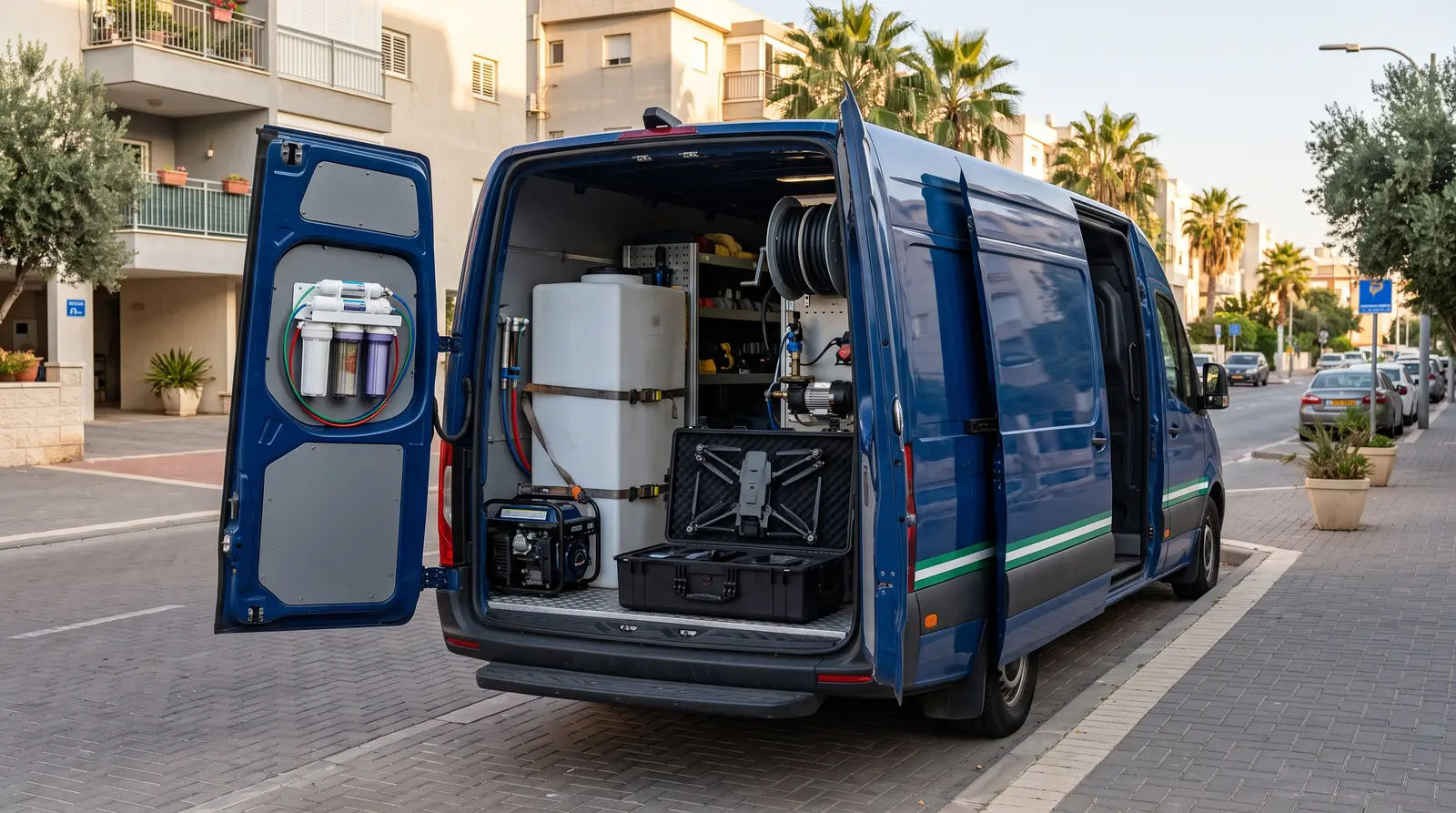 אוסמוז
The second vehicle, for site surveys, is a second-hand van from 2018-2020 bought for cash between 35 000 and 55 000 ₪. It carries nothing heavy: buying new makes no sense here.
11.3Pressure washing, our first trade
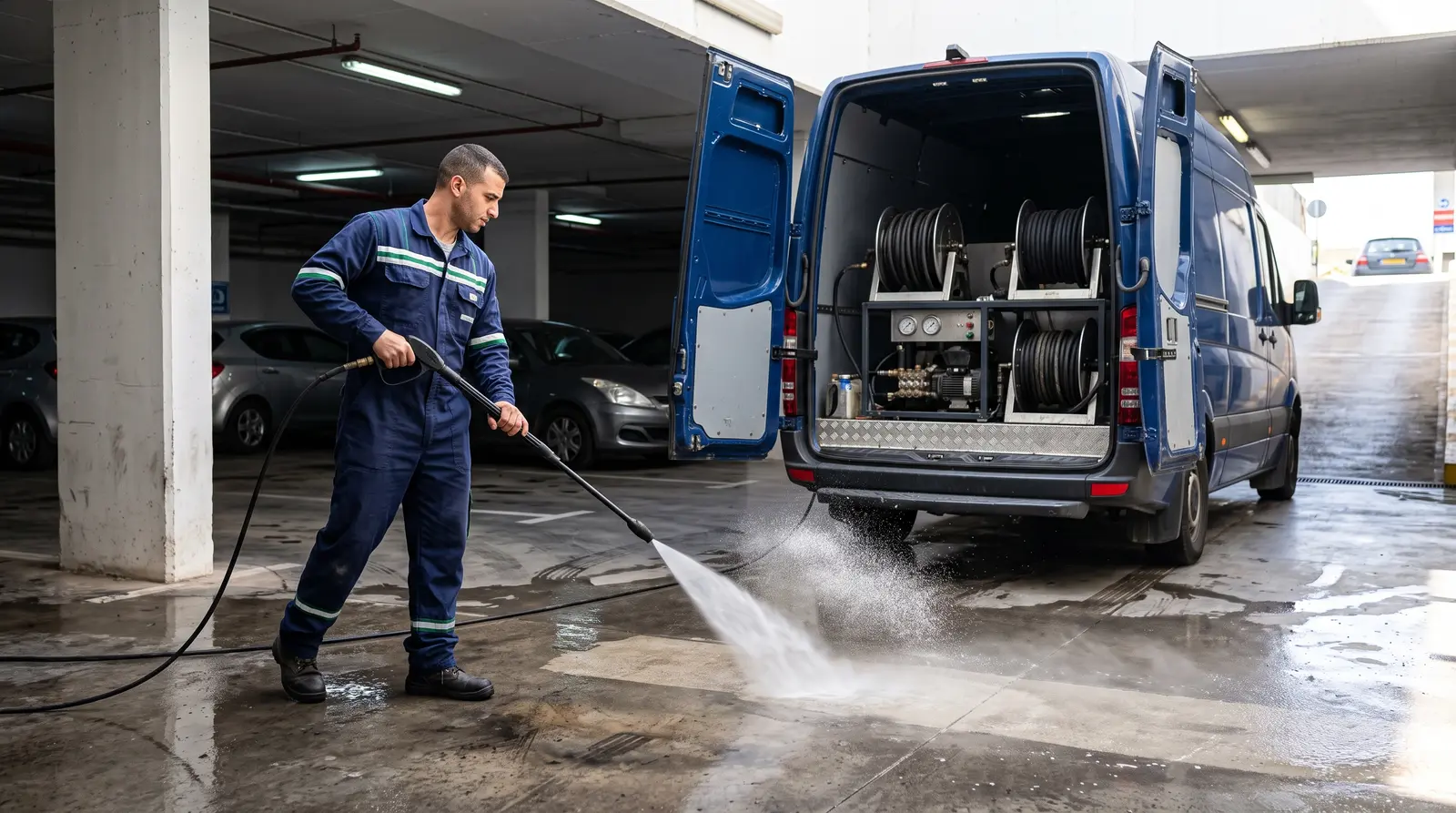 אוסמוז
| Equipment investment | Amount | Month |
|---|---|---|
| 400 L tank, reverse-osmosis unit, generator, pump, hose reels, PPE, safety marking | 40 000 ₪ | 2 |
| Additional high-pressure kit for the ground-level business | 60 000 ₪ | 2 |
| Van racking and fit-out, and wrap for both vehicles | 25 000 ₪ | 4 |
12The price list
What we sell at, how that price is built, and what it produces in the financial forecast.
12.1Prices by building sizeExplanations
Prices including VAT, full façade, washed with osmosis water. The Israeli market sits between 5.5 and 10 ₪ per square metre; we are in the middle of that band, never below it.
| Size | Price incl. VAT | Per flat | Time on site |
|---|---|---|---|
| 4 storeys | 5 600 ₪ | 700 ₪ | 1 day |
| 6 storeys | 7 700 ₪ | 642 ₪ | 1.5 days |
| 8 storeys | 9 700 ₪ | 606 ₪ | 2 days |
| 12 storeys | 17 100 ₪ | 712 ₪ | 3 days |
| 15 storeys | 22 500 ₪ | 750 ₪ | 4 days |
| 20 storeys | 31 400 ₪ | 785 ₪ | 5.5 days |
| Ground-level pressure washing | 4 000 ₪ | — | per day |
On top come the market’s customary surcharges, taken from the only scale published in Israel: seaside +20%, heavy soiling +15 to 30%, urgent job within fifteen days +20%. And two discounts that serve our schedule rather than the rebate: a second adjoining building on the same day −10%, off-season signature −10%.
12.2What the price list changes in the forecast
| Activity for the month | Days used | Revenue | Margin after costs |
|---|---|---|---|
| 5 jobs + 7.8 days of pressure washing | 17 | 80 260 ₪ | + 923 ₪ |
| 6 jobs + 6 days of pressure washing | 17 | 82 712 ₪ | + 3 081 ₪ |
| 7 jobs + 4.1 days of pressure washing | 17 | 85 164 ₪ | + 5 238 ₪ |
| 9.2 jobs, saturation | 17 | 90 654 ₪ | + 10 069 ₪ |
| Two crews at saturation, administrator included | 34 | 181 309 ₪ | + 49 046 ₪ |
Hence the decisive importance of the rate. At 750 m² a day the margin vanishes — minus 500 ₪. At 600, the crew loses 11 900 ₪ a month. At 1 100, it earns 22 900. No other parameter in this dossier has that amplitude, and it is measured on the first three jobs.
 אוסמוז
§Sources and references
·Regulation
- תקנות הטיס (הפעלת מערכת כטב״ם קטן), התשפ״ד-2024 — official text, statute book no. 3192
- תקנות הטיס (הפעלת כלי טיס וכללי טיסה), התשמ״ב-1981 — the regime above 25 kg
- Civil Aviation Authority — licences and registration
- פמ״ת / AIP — aeronautical information
- ICD — collective operating authorisation 2024-2028
- Drones and privacy protection in Israeli law
·Market and competition
- Israeli housing stock — Central Bureau of Statistics data
- Residential towers by city — Calcalist
- Residential construction report 2024
- Rope access work rates in Israel
- Cost comparison, rope access against boom lift
- E-DRONE · Aquadrone · KTV Working Drone · DXG Drone Services
·Employment and tax
- Minimum wage — 6 443.85 ₪ since 1 April 2026
- Ford Transit 399L — spec sheet and 2026 price · Official Renault Israel price list · Peugeot Boxer price list, 30 April 2026 · Official Isuzu Israel price list · S Plus 4X4 spec sheet
The market
Decisions and positions taken
| Question | Position taken |
|---|---|
| Which segment | Multi-unit residential of 4 to 15 storeys, and not industry. All five Israeli drone operators target Intel, the Israel Electric Corporation and Dead Sea Works. None has a verifiable residential reference |
| Which cities first | Bat Yam, Ashdod, Netanya. Vertical density and salt corrosion in the same place. A coastal façade degrades in 2 to 3 years against 10 inland |
| Against whom | Against the boom lift, not against the rope access technician. The boom lift is already 20 to 30% cheaper than rope access on 4 to 6 storeys — that is what has to be beaten |
| On what | Not on price. On the street left clear, on the absence of drilled anchors, on half the time on site, and on the photo report handed to the property management company |
| The pilot | Recruited already licensed, never trained in-house. Five months of salary saved, and no funded licence that can walk out with its holder |
The market price survey
| Method | Observed price | Constraints |
|---|---|---|
| Rope access, per day | 3 000 to 3 500 ₪ · 3 300 to 5 900 ₪ for façade and glazing | +15 to 25% above the 11th storey, +25 to 40% above the 20th, +20% in the coastal strip, +20% at night |
| Flat rate, 6 to 8 storeys | 6 000 to 15 000 ₪ | The only flat rate published anywhere on the Israeli market |
| Boom lift with operator | 2 500 to 4 000 ₪ a day · 500 to 1 200 ₪ an hour depending on height | 20 to 30% cheaper than rope access up to 6 storeys, but a highway permit is required |
| Boom lift, bare rental | 80 to 1 000 ₪ a day + 250 to 600 ₪ of transport | No operator, rate tapers on long hire |
| Pressure washing, published price | 15 ₪/m², tapering from 2 to 30 | Only one provider publishes a price per m² in Israel |
| Office glazing | 200 to 500 ₪ per window | The most recurring and the best-paid segment |
| Solar panels in residential buildings | 700 to 1 300 ₪ per visit | Two-visit subscription 1 200 to 1 800 ₪/year, 10 to 20% discount |
Who decides, who pays
The budget is voted at a general meeting. Typical running budget of a twenty-flat building: 24 200 ₪ a year, that is about 101 ₪ per flat per month, including a reserve fund of about 2 200 ₪. A façade clean at 6 000-15 000 ₪ therefore represents 25 to 60% of the annual running budget — the spend never goes through as running cost.
The fast decision-maker is not the volunteer ועד בית, it is the property management company on the buildings it runs under mandate, and the facility manager on the office side. The E-DRONE × Electra FM partnership validates exactly that channel.
The housing stock
2.96 million homes, +61 200 a year. In 2024, 47.5% of new homes were in buildings of nine storeys or more. Towers of 16 storeys and above started in 2023: Bat Yam 1 486, Ashdod 732, Lod 697, Netanya 694, Rishon LeZion 651, Tel Aviv 426.
The solution
Decisions and positions taken
| Question | Position taken |
|---|---|
| Which aircraft | Two aircraft under 25 kg, from two different makes. The Hercules 10 Tethered Spray and the DJI Matrice 400 with a cleaning kit |
| Why two makes | The cleaning-drone market is young. Six months of side-by-side operation teach more than a year of spec sheets. Whichever model holds up becomes the standard for the second crew |
| Water supply | A hose from the ground. A façade consumes hundreds of litres, and a tonne of water does not fly. The payload capacity therefore does not need to be huge |
| Red line | 25 kg at take-off, payload included. Above that, operations fall under the 1981 regulation, written for manned aviation |
What the mass constraint rules out
| Aircraft | Mass | Verdict |
|---|---|---|
| DJI Agras T25 | 32 kg | Ruled out — 25.4 kg empty |
| DJI Agras T50 | 52 kg | Ruled out |
| DJI Agras T100 | 75 to 90 kg | Ruled out |
| XAG V40 / P100 / P150 | 28 to 51 kg | Ruled out |
| Aerones | 55 kg | Ruled out, and not sold here |
| Drone Volt Hercules 20 | MTOW 33 kg | Ruled out — 8 kg too heavy |
| Hercules 10 Tethered | MTOW 20 kg | Selected |
| DJI Matrice 400 | MTOW 15.8 kg | Selected |
The business model
Decisions and positions taken
| Question | Position taken |
|---|---|
| Unit of account | The crew day, not the number of jobs. A four-storey block and a tower share neither price, nor duration, nor margin |
| Price positioning | In the middle of the market band, 5.2 to 7.5 ₪ per m², never below. The market sits between 5.5 and 10 |
| Absolute floor | 4 800 ₪ per day mobilised. A one-day job at 4 200 ₪ is not a thin margin, it is a loss |
| Renewal cycle | One pass every two to three years in residential. An annual pass would represent 50 to 62% of a building’s running budget — unvotable |
| Where the recurrence is | Not in residential. In solar panels, offices and property management companies |
The base price list, incl. VAT
| Size | Façade | Price | Per flat | Time on site |
|---|---|---|---|---|
| 4 storeys | 744 m² | 5 600 ₪ | 700 ₪ | 1 day |
| 6 storeys | 1 188 m² | 7 700 ₪ | 642 ₪ | 1.5 days |
| 8 storeys | 1 680 m² | 9 700 ₪ | 606 ₪ | 2 days |
| 12 storeys | 2 736 m² | 17 100 ₪ | 712 ₪ | 3 days |
| 15 storeys | 3 600 m² | 22 500 ₪ | 750 ₪ | 4 days |
| 20 storeys | 5 040 m² | 31 400 ₪ | 785 ₪ | 5.5 days |
What the building committee can actually vote
| Size | Per flat | 1× a year | 1× / 2 years | 1× / 3 years |
|---|---|---|---|---|
| 4 storeys | 700 ₪ | 58% of the budget | 29% | 19% |
| 6 storeys | 642 ₪ | 53% | 26% | 18% |
| 8 storeys | 606 ₪ | 50% | 25% | 17% |
| 15 storeys | 750 ₪ | 62% | 31% | 21% |
An annual clean would raise the service charges by 50 to 62%. That cannot be voted through. Every two to three years, it falls back to 17-31% — and that is exactly the frequency rope access technicians recommend on technical grounds. The reserve fund, for its part, would need five to seven years of saving, hence the payment in three or four instalments offered from the outset.
Surcharges and discounts
Storeys 11 to 20 +15 to 25% · above the 20th +25 to 40% · seaside +20% · heavy soiling +15 to 30% · urgent job within fifteen days +20%. A second adjoining building on the same day −10% · off-season signature −10% · a committed two-pass contract −15%, reserved for the channels where recurrence can be voted: solar, offices, property management companies.
Where a subscription works
| Channel | Frequency | Format |
|---|---|---|
| Residential building | 1× / 2-3 years | No subscription — a general-meeting vote, no VAT to reclaim |
| Solar panels in residential buildings | 2× / year | Subscription — 10 ₪ per flat per month, votable |
| Property management company | depends on the portfolio | Framework contract — decided without a general meeting |
| Offices, facility | 3 to 4× / year | Subscription — operating budget |
| Shops, shopfronts | monthly | Subscription |
The regulatory barrier
Decisions and positions taken
| Question | Position taken |
|---|---|
| Applicable text | תקנות הטיס (הפעלת מערכת כטב״ם קטן), התשפ״ד-2024, in force since 11.08.2024 |
| What blocks us | תקנה 32(א)(2) imposes a minimum distance equal to the greater of the flight height or 50 metres. Cleaning an occupied façade is therefore impossible under the standard regime |
| The way out | הרשאה להפעלה מיוחדת, תקנות 37-43. Granted on the quality of a risk management plan, revocable, non-transferable |
| Municipalities | No municipal flight authorisation. Civil aviation is an exclusively national competence. Only the work at ground level falls to the town hall — and the drone escapes it most of the time |
| Lead time per job | Seven working days of coordination with מודיעין טיס, structurally incompressible. Hence a commercial promise at ten days |
What the authorisation implies
| Feature | What it means for us |
|---|---|
| Granted to an operator, not to a mission | A single authorisation would cover the whole activity — to be confirmed in writing |
| Risk management plan, תקנה 38 | Design and drafting work, not a counter formality |
| Proof of competence, תקנות 39-40 | A further theory or practical examination is possible for our pilots |
| Conditions imposed: headcount, scope, duration, area | Our internal procedures must be written before they can be authorised |
| Suspension of up to one year, appeal within 30 days, תקנה 43 | Day-to-day compliance becomes an asset to protect |
We file the first applications ourselves
As soon as the drones are delivered, the partners personally fly the first tests and file the first coordinations, before any administrative hire. First, because you do not write a procedure you have never carried out: the operating method later handed to the administrator will come out of what we have lived through. Second, because a director who knows the procedure in detail defends his file better before the authority. The administrator is recruited only once the process has been run in, at around fifteen coordinations a month.
The six critical questions put to the lawyer
| Ref | Question | What it decides |
|---|---|---|
| A2 | Does the 25 kg threshold include the water load? | The choice of equipment |
| A6 | Is the threshold assessed on the manufacturer’s MTOW or on the mass as actually configured? | Rules out or brings back several models |
| B1 | Does תקנה 32(א)(2) indeed rule out cleaning an occupied façade in practice? | Feasibility itself |
| B2 | Does the הרשאה להפעלה מיוחדת allow a waiver from it? Is there a precedent? | Feasibility itself |
| B3 | Does a single authorisation cover all our job sites, or is one application needed per building? | The whole business model |
| B8 | Can the application be filed before the drones are bought and registered? | 270 000 ₪ tied up or not |
The timeline, tightened
Month 1 company, van and aircraft ordered, recruitment started, website and CRM · Month 2 delivery and fit-out, registration, spectrum authorisation, field pair in post mid-month · Month 3 authorisation application filed, pressure washing in production, campaign launched at day 90 · Months 4-6 file under review, first residential leads, order book built · as soon as the authorisation lands first billable drone job.
Operations
Decisions and positions taken
| Question | Position taken |
|---|---|
| Crew composition | Two people: a drone pilot and a crew leader who holds the visual watch and the ground |
| Vehicle | A panel van above 3.5 t, 1 714 kg of payload, 12.4 m³. The drone travels under cover, dry and locked away |
| Water capacity | A 400-litre buffer tank, not 1 000. A cubic metre of water weighs a tonne. Continuous supply comes from the building’s water point through the reverse-osmosis unit |
| Second trade | Ground-level pressure washing runs on the same van and the same equipment. It invoices from the third month, funds the review of the file and fills the windy days |
The payload budget, line by line
| Item | Mass |
|---|---|
| Crew, two people | 170 kg |
| 400 L buffer tank, full | 435 kg |
| Generator | 70 kg |
| Reverse-osmosis unit and pre-filters | 40 kg |
| High-pressure pump | 60 kg |
| Hose reels and hoses | 50 kg |
| Drone in its transport case | 45 kg |
| PPE, safety marking, consumables | 60 kg |
| Total | 930 kg out of 1 714 available |
The cycle of a job
T−15 pre-visit and site survey · T−10 flight coordination filed, seven working days minimum · T−7 residents informed and written agreement from the property management company · T−1 weather and restrictions check · T0 safety marking, call to the control unit, visual observer at all times · T+1 mission report, invoicing, review request.
The forecast
Decisions and positions taken
| Question | Position taken |
|---|---|
| Funding | 600 000 ₪ of founders’ equity + 369 000 ₪ of balloon loan on the van and the drones. No working capital loan: the cash position never turns negative |
| What we ask of the bank | A business account, the best rate on the equipment balloon loan, and a 100 000 ₪ overdraft facility that costs nothing as long as it is not drawn |
| Vehicles and aircraft | Balloon loan pledged in favour of the lender. The pledge is worth about four points of interest: 5.3% effective recorded against 9.5% without a pledge. The forecast nevertheless keeps 8%, as long as no bank quote is signed: that is the prudent assumption, and every point of rate gained is worth more than 10 000 ₪ over forty-eight months |
| Partners’ salaries | Zero in the first year. Remuneration at the year end, out of profit |
| The field pair | In post mid-month 2, pilot recruited already licensed. He produces pressure washing revenue from month 3 |
| Second crew | On measured triggers only: 14 of the 17 production days booked, two months running |
The choice of drone
What was ruled out, and why
| Aircraft | Mass | Verdict |
|---|---|---|
| DJI Agras T25 | 32 kg | Ruled out — 25.4 kg empty, already above the threshold |
| DJI Agras T50 | 52 kg | Ruled out |
| DJI Agras T100 | 75 to 90 kg | Ruled out — seven times the threshold |
| XAG V40 / P100 / P150 | 28 to 51 kg | Ruled out |
| Aerones | 55 kg | Ruled out, and not sold — service provision only |
| Drone Volt Hercules 20 | MTOW 33 kg | Ruled out — 8 kg above the threshold |
| Hercules 10 Tethered | MTOW 20 kg | Selected — 5 kg of margin |
| DJI Matrice 400 | MTOW 15.8 kg | Selected — 9.2 kg of margin |
The two aircraft selected
| Hercules 10 Tethered Spray | DJI Matrice 400 + kit | |
|---|---|---|
| Origin | France — Villepinte | China |
| Empty mass | 8.5 kg manufacturer · 10 | 9.74 kg DJI · 10 |
| MTOW | 20 kg manufacturer · 10 | 15.8 kg DJI · 10 |
| Payload | 7.5 kg | 6 kg |
| Margin under 25 kg | 5 kg guaranteed by the MTOW | 9.2 kg guaranteed by the MTOW |
| Water supply | A hose from the ground — the meaning of “Tethered” | Third-party kit fed from the ground integrator · 6 |
| Endurance | Not published | 59 min DJI · 10 |
| Wind limit | Not published | 12 m/s DJI · 10 |
| Distributor in Israel | None — direct import from France dronevolt.com · 8 | FlySafe, DJI Enterprise distributor official · 8 |
Import, line by line
| Item | Rate | Detail |
|---|---|---|
| Tariff code | 8806.23 | Unmanned aircraft of 7 to 25 kg |
| Customs duty | 0% | All origins, until 31 May 2028 |
| Purchase tax | 0% | Exempt |
| Import VAT | 18% | On the CIF value — recoverable, a drone is not a vehicle |
| Customs broker | 1 500 to 4 000 ₪ | Market estimate, to be quoted |
| Delivered cost | 118 000 to 133 000 ₪ on the basis of the only published pack, 26 850 € excluding VAT | |
No Ministry of Defence control for an import destined for Israel — the two security authorisations in the tariff cover only the West Bank and Gaza. And no public list of models approved by the CAA: registration is done aircraft by aircraft, on file.
The choice of vehicle
Why a panel van and not a pickup
| Over five years | D-Max S Plus | Transit 399L |
|---|---|---|
| List price | 300 990 ₪ | 289 000 ₪ |
| Recoverable VAT | 0 ₪ | − 44 085 ₪ |
| Deductible costs | 45% | 100% |
| Enclosed volume | 1.18 m³ | 12.4 m³ |
| Payload | 1 080 kg | 1 714 kg |
| Total cost | 300 990 ₪ | 208 508 ₪ |
The ten panel vans compared
| Model | Price incl. VAT | Gross weight | Payload | Volume | Verdict |
|---|---|---|---|---|---|
| Ford Transit 399L | 289 000 ₪ | 3 990 | 1 714 kg | 12.4 m³ | Selected |
| Renault Master 3.99T L3H2 | 354 000 ₪ | 3 990 | 1 738 kg | 13.0 m³ | Fallback |
| Renault Master 3.99T L2H2 | 348 100 ₪ | 3 990 | 1 811 kg | 10.8 m³ | Compliant |
| Iveco Daily L4H2 | 325 000 ₪ | 3 800 | 1 452 kg | 16.0 m³ | If volume comes first |
| Fiat Ducato POWER XL | 389 400 ₪ | 3 995 | 1 810 kg | 13.4 m³ | Expensive |
| Peugeot Boxer L4H3 | 380 000 ₪ | >3 500 | 1 745 kg | 17.0 m³ | Expensive |
| Renault Master 3.5T | ≤390 000 ₪ | 3 500 | 1 360 kg | 10.8 m³ | Only B-licence option |
| Mercedes Sprinter 316 | 340 000 ₪ | 3 550 | 1 250 kg | 14.0 m³ | Ruled out |
| VW Crafter 3.5t | 398 250 ₪ | 3 500 | 1 009 kg | 14.4 m³ | No payload margin |
| Sprinter 314 entry level | 275 000 ₪ | 3 550 | 990 kg | 7.8 m³ | No payload margin |
The pickups examined
| 4×4 model | Price incl. VAT | Payload | Bed volume |
|---|---|---|---|
| Isuzu D-Max 1.9 S Plus | 300 990 ₪ | 1 080 kg | 1.18 m³ |
| Toyota Hilux Active Pro | 309 990 ₪ | 1 000 kg | 1.15 m³ |
| Ford Ranger XLT | 294 000 ₪ | 1 000 kg | 0.98 m³ |
| KGM Musso 2.2 | 274 900 ₪ | ~1 000 kg | not found |
| Mitsubishi L200 | No longer sold new in Israel in 2026 | ||
The second vehicle
The financial forecast carried 130 000 ₪. That is three times too much for a vehicle that does site surveys and carries nothing heavy. Second-hand market values: Berlingo 2018-2020 from 30 800 to 69 700 ₪, Doblo from 22 400 to 41 200 ₪, Kangoo 2019-2021 from 29 600 to 49 900 ₪. Target: 35 000 to 55 000 ₪ in cash after a בדיקת רכב (vehicle inspection), that is about 43 000 ₪ saved over thirty months.
Wrap, fit-out, trailer
| Item | Budget | Source |
|---|---|---|
| Full wrap on one van | 5 500 ₪ + 500 ₪ | Actual customer quote midrag · 6 |
| Partial lettering | 750 to 1 500 ₪ excluding VAT | Best visibility for the money midrag · 6 |
| Modular racking | 2 500 to 4 000 ₪ | Supplier’s own statement roimitech · 4 |
| Bespoke fit-out | 10 000 to 30 000 ₪ | No public rate · 4 |
| Basic open trailer | from 4 900 ₪ excluding VAT | Published price list nissenboim · 5 |
| Drop-side trailer, 2 t and above | from 14 500 ₪ excluding VAT | Braking sends the price up |
| Commercial vehicle insurance | 6 500 to 8 500 ₪ a year | Official quotes on car.cma.gov.il midrag · 4 |
| Annual roadworthiness test ≤ 8 t | 126.19 ₪ | Official rate 01.06.2026 m-rishuy · 8 |
The price list
How it was built
| Method | Day rate | Price per m² |
|---|---|---|
| Rope access, entry level | 3 300 ₪ | 5.5 ₪/m² |
| Rope access, top of the range | 5 900 ₪ | 9.8 ₪/m² |
| Boom lift with operator | 4 750 ₪ | 6.8 ₪/m² |
| Published pressure washing | — | 15 ₪/m² |
| Our price list | — | 5.2 to 7.5 ₪/m² |
This market is not sold by the square metre
Not the rope access firms, not the boom lift operators, not the scaffolders. They sell by the crew day and as a fixed price per building. Only one provider publishes a price per m² in Israel. Our price list is therefore built per m² internally and presented to the client as a fixed price — a ועד בית thinks in shekels per flat, not in square metres of façade.
Sensitivity to the rate
| Washing rate | Jobs per month | Summer monthly revenue | Margin |
|---|---|---|---|
| 600 m² per day | 6.7 | 65 671 ₪ | −11 916 ₪ |
| 750 m² per day | 8.0 | 78 681 ₪ | −467 ₪ |
| 900 m² per day — adopted | 9.2 | 90 654 ₪ | +10 069 ₪ |
| 1 100 m² per day | 10.7 | 105 209 ₪ | +22 877 ₪ |
| 1 300 m² per day | 12.1 | 118 365 ₪ | +34 455 ₪ |
We have deliberately set aside the “80 to 90% less time” claimed by competitors: the washing itself speeds up a great deal, but the set-up, the water supply, the safety perimeter and the observer do not compress. 900 m² a day, about one and a half times a rope access crew, is prudent. To be measured stopwatch in hand on the first three jobs, separating actual washing time from the rest.